Building your startup’s first product can be exciting — but it’s also where many founders get stuck or go broke. You have the idea, the drive, maybe even early validation, but then comes the question every cost-sensitive founder faces: How much does it actually cost to build an MVP?
This article is designed for price-sensitive founders who want a clear, practical understanding of MVP budgeting — how much to expect, what influences cost, and how to plan smartly without burning through limited funds. By the end, you’ll know how to maximize every dollar and turn your MVP into a launchpad for growth rather than a financial burden.
Understanding What An MVP Really Is
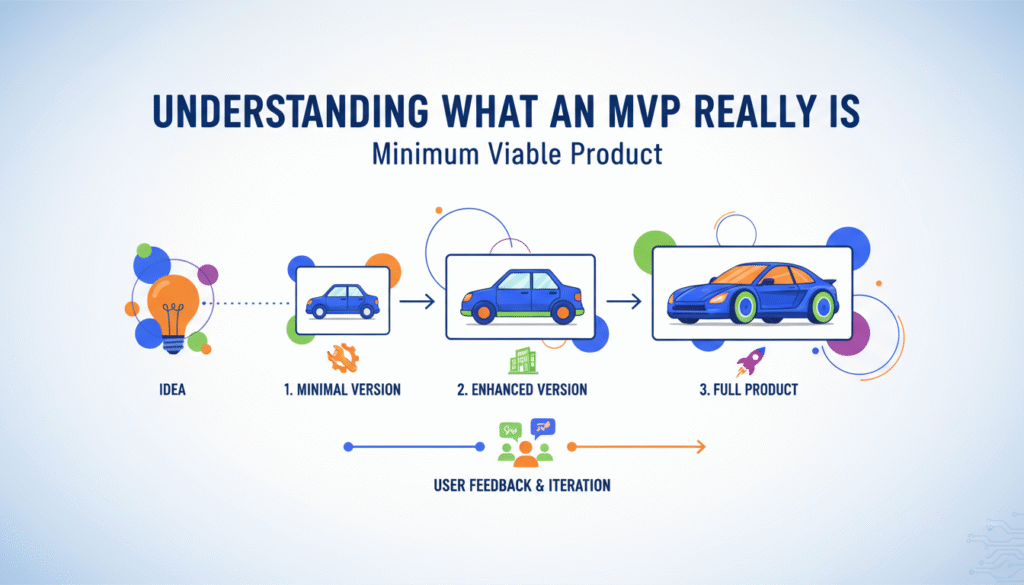
Before you start allocating budgets or hiring developers, it’s essential to understand what an MVP (Minimum Viable Product) truly represents.
An MVP isn’t a half-finished product or a stripped-down prototype. It’s a strategically built version of your product that includes only the core features necessary to test your business hypothesis. The goal isn’t perfection — it’s validation.
By releasing a minimal version, you can collect user feedback, analyze engagement, and see if the product actually solves a real problem. If it does, you’ll have data to attract investors or justify further investment. If it doesn’t, you’ll pivot early without wasting months and thousands of dollars on a full-scale build.
Think of your MVP as a learning tool, not a final deliverable. It helps you validate demand, measure usability, and understand market fit — all at a fraction of the cost of a full-featured app.
Why Budgeting Matters Before You Start Building
Budgeting, while it isn’t the sexiest of tasks, is in fact a crucial component that distinguishes a well thought out MVP from a doomed venture. Without a clear plan of where your finances are going, its alarmingly easy to blow your budget, over estimate the time it will take to complete the project or just plain quit on it when it gets tough.
1. Prevents Running Out of Money Mid-Project
Startups have a nasty habit of crashing and burning at the halfway point because they never quite got the costs nailed down. Map out your financial constraints early on though and you can set some fairly realistic targets, pick tools that won’t break the bank and avoid scrambling for emergency funding down the line.
2. Keeps You Focused on Priorities
With a tight budget you cant really afford to waste money on every half baked idea that comes along. Budgeting forces you to separate the “needs” from the “nice to haves”. It helps align your grand vision with the harsh reality of your financial situation, letting you focus on the one or two things you really need to get right to see if your concept has any legs.
3. Makes Investor Conversations Easier
When you’re on top of your numbers -likely costs, timelines and the potential return on investment -then investors are going to take you a lot more seriously. A clear budget shows that you’re a serious player who can manage your finances and think strategically -two things that every single investor is looking for when putting their money in a venture.
4. Reduces Stress and Increases Transparency
Its worth noting that budgeting isnt just about saving a buck; its also about getting that nagging feeling of “what if” out of your head – You’ll know exactly what to expect, how to allocate funds and how to track progress. And if you’re working with a team, or even a partner, a clear financial roadmap can also help you build trust and keep everyone on the same page.
What An MVP Typically Costs
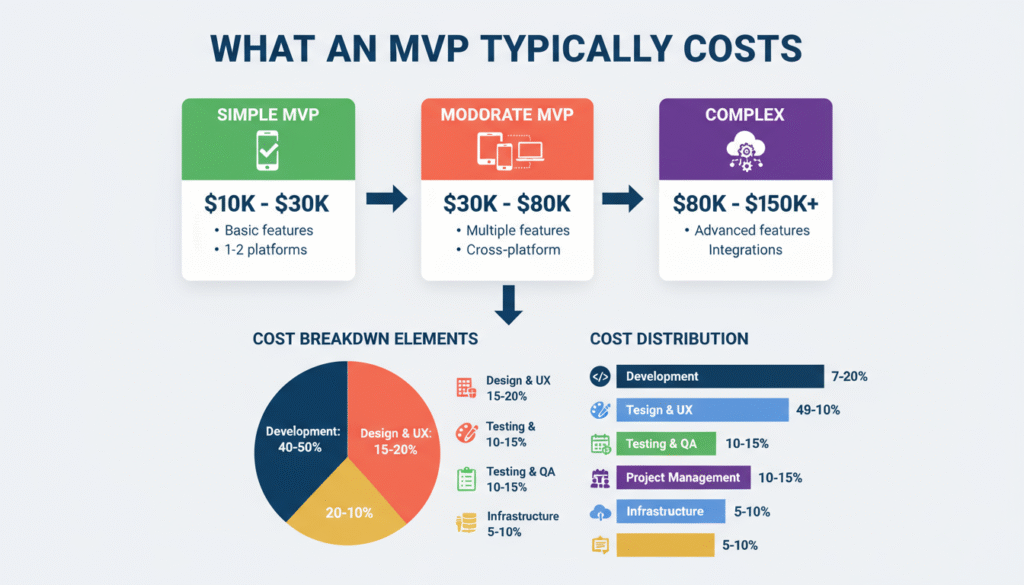
While every startup is unique, most MVPs fall into predictable cost brackets. The variation depends on complexity, design, and team geography — but here’s what you can expect:
- Simple MVP:
Basic functionality (login, dashboard, one core feature, minimal UI) — around $10,000 – $30,000, especially when outsourced to cost-effective regions. - Moderate MVP:
User authentication, multiple screens, APIs, admin panels, and refined UX — usually $30,000 – $80,000. - Complex MVP:
Multi-platform builds, real-time features (chat, maps, AI), payment systems, and enterprise-level architecture — often $100,000 – $150,000 or more.
Keep in mind, these numbers include design, development, testing, and initial deployment. Maintenance, scaling, and marketing are additional.
If you’re building in a cost-sensitive region like South Asia or Eastern Europe, you can often achieve comparable quality at the lower end of these ranges — provided you maintain strict control over scope and project management.
Factors That Influence MVP Costs
1. The Number of Features You Include
Each feature you add multiplies cost, not linearly but exponentially. Every button, workflow, or screen needs design, development, and testing time. The leaner your MVP, the lower your cost. Identify your must-have features — the core actions that allow users to test the value of your product. Everything else can wait for version 2.
2. Platforms You Target
Building for both iOS and Android doubles work if you use native development. Instead, opt for cross-platform frameworks like Flutter or React Native — these let you build once and deploy everywhere. Web-only MVPs are even cheaper if your audience doesn’t specifically require mobile apps yet.
3. Design and User Experience
At the MVP stage, you don’t need award-winning UI. Focus on clean, simple, and functional design. Custom illustrations and animations add cost but not necessarily validation value. A minimal interface that communicates your core idea works just fine for now.
4. Development Team and Location
Hiring a full-time, in-house team in a high-cost country like the US or UK can quickly drain your funds. Many early founders save money by outsourcing development to reputable teams in regions like South Asia or Eastern Europe, where you can get experienced developers at a fraction of the cost.
5. Tech Stack and Tools
Using open-source frameworks, no-code tools, or existing APIs can drastically reduce both time and expense. Avoid reinventing the wheel — use ready-made authentication, payment, and database systems where possible.
6. Maintenance and Hidden Costs
Many founders forget to plan for what comes after launch — server hosting, bug fixes, updates, and customer support. Always reserve around 10–20% of your total MVP cost for post-launch maintenance.
7. Project Management and Communication
Poor communication or unclear project scope leads to scope creep — those “just one more feature” moments that destroy budgets. Define clear milestones, timelines, and deliverables before the first line of code is written.
How To Plan A Smart MVP Budget
Now let’s look at how to create a practical, realistic budget even with limited funds.
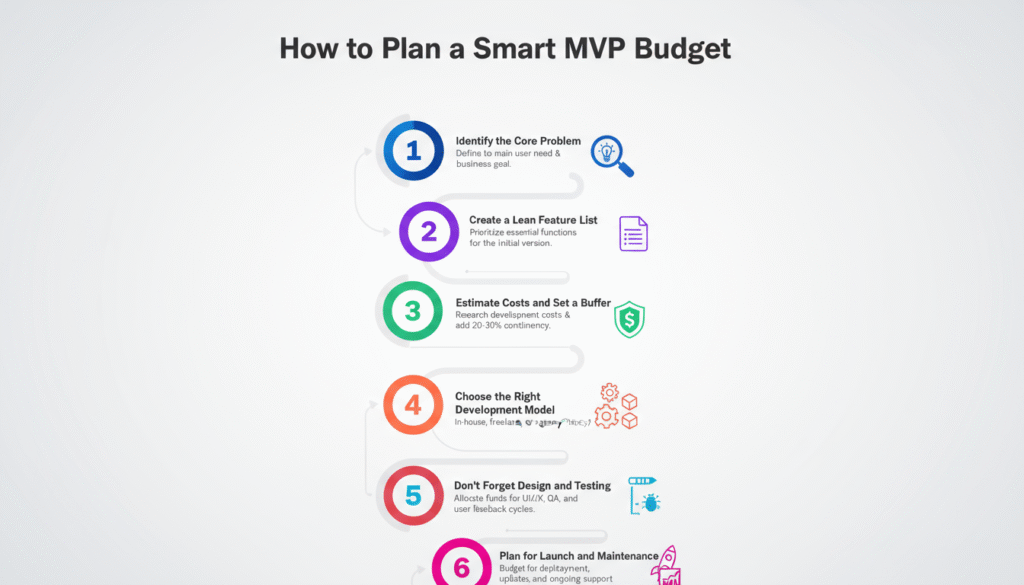
Step 1: Identify the Core Problem
The first step in planning a smart MVP budget is to define the core problem your MVP aims to solve. Your MVP should test one key assumption: does your solution effectively address the issue at hand? To ensure clarity, list out the features of your product and distinguish which ones are essential for solving this problem. Anything else can be considered secondary and can be developed later.
Step 2: Create a Lean Feature List
Once you have identified the core problem, it is essential to build a lean feature list for your MVP. Focus on developing around 3 to 5 must-have features that are critical to the product’s purpose. This approach maintains a compact and budget-friendly project, ensuring that the MVP remains functional enough for user testing.
Step 3: Estimate Costs and Set a Buffer
After determining the necessary features, it’s time to consult your development team for cost estimates. Being proactive with budgeting is crucial; always include a 10-15% buffer to accommodate unexpected expenses, as MVP projects can often exceed initial estimations due to revisions or testing requirements.
Step 4: Choose the Right Development Model
For early-stage founders, opting to outsource to a small, dedicated team or freelancers can be a cost-effective choice. Steer clear of hourly contracts without milestones, as fixed-price or milestone-based agreements provide better control over your budget and project progress.
Step 5: Don’t Forget Design and Testing
A good user experience (UX) can significantly impact your product’s success. Even if you’re working with limited funds, invest in basic wireframes and conduct user flow testing to create a product that feels intuitive for your users.
Step 6: Plan for Launch and Maintenance
Finally, as you prepare for launch, set aside funds for essential needs such as domain registration, hosting, and minor bug fixes post-launch. It’s vital that your MVP works smoothly as users begin testing it; you don’t want it to crash at a critical moment.
What A Realistic Budget Looks Like
Here’s an example for a lean but practical MVP budget:
| Stage | Estimated Cost (USD) | Notes |
|---|---|---|
| Product Discovery & Design | $2,000 – $5,000 | Wireframes, branding, UX flow |
| Development (Core Features) | $8,000 – $20,000 | Single platform, essential features |
| QA & Testing | $1,000 – $3,000 | Functional and user testing |
| Hosting & Launch Setup | $500 – $1,000 | Servers, deployment tools |
| Maintenance (3–6 Months) | $1,000 – $2,000 | Updates, monitoring, bug fixes |
| Total Estimated Cost | $15,000 – $30,000 | Depending on complexity & region |
The Mindset That Helps To Succeed
MVP budgeting isn’t just about money — it’s about mindset. The goal is to learn fast, spend slow, and adapt early. Your first version doesn’t need to be perfect. It needs to deliver insight — real feedback from real users.
The best founders treat their MVP as an experiment, not a final product. They measure how people use it, what they ignore, and what they love. Then they reinvest in the features that matter and drop the rest. This lean approach ensures you’re not wasting resources on guesswork.