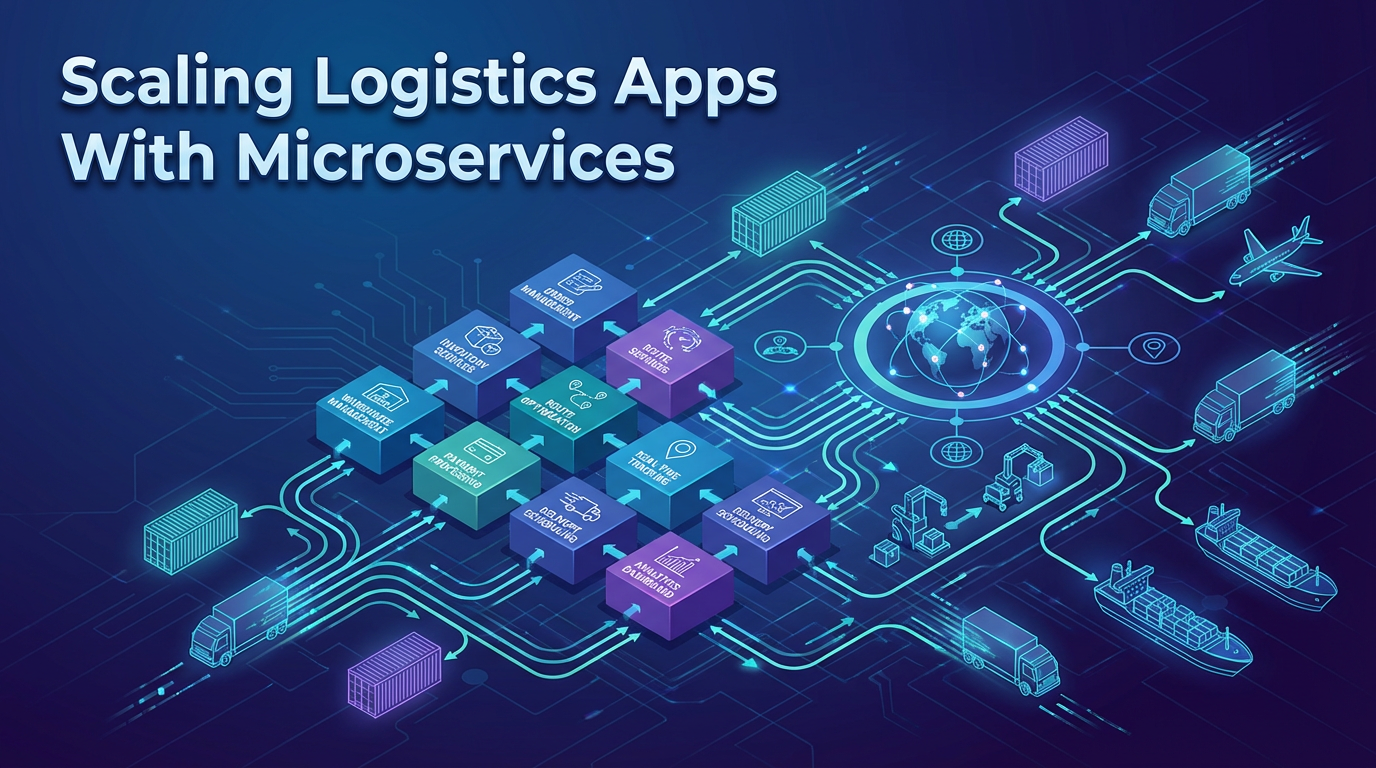
Modern logistics platforms handle far more than simple pickup-and-drop operations. They manage real-time tracking, fleet optimization, API-driven integrations with carriers, route computation, warehouse operations, billing, compliance, IoT sensors, and customer visibility—all at once.
As demand grows, legacy monolithic architectures struggle to keep up. That’s why logistics companies are increasingly migrating to microservices. Microservices offer a modular, distributed architecture that allows logistics applications to scale fast, deploy independently, and integrate deeply with partners and automation tools.
This blog explains why microservices matter for logistics, the components typically separated into services, and how B2B teams can plan an enterprise-grade microservices transformation.
Microservices Fit the Logistics Industry

Logistics is one of the most complex, data-intensive, and integration-heavy industries. Every order triggers hundreds of micro-events—from driver assignment to GPS updates, warehouse scanning, invoicing, compliance checks, and customer notifications. Traditional monolithic systems struggle to keep up with this scale and variability, which is why logistics platforms worldwide are adopting microservices as their core architecture.
1. High Operational Complexity
The logistics industry deals with unpredictable workloads and an enormous number of operational events. During seasonal peaks, order volumes can double or triple, while driver apps, IoT devices, warehouse scanners, and fleet systems continuously generate real-time data. A monolithic system often becomes overloaded under this pressure because all functions are tightly coupled and share the same resources.
Microservices break this complexity into smaller, independent services—such as dispatch, tracking, warehouse operations, pricing, or billing—which can scale separately. This ensures that a heavy load on one function does not slow down the entire system.
Main Features
- Handles surge workloads during seasonal or monthly demand spikes
- Supports constant updates from driver apps, GPS units, and IoT sensors
- Prevents bottlenecks by isolating warehouse, route planning, billing, and tracking into separate services
- Improves responsiveness and system stability during high traffic periods.
2. Real-Time Data Requirements
Real-time visibility is essential in logistics because operational decisions depend on up-to-second data—vehicle locations, route changes, warehouse scans, and sensor readings. Monolithic systems typically struggle to process such continuous high-frequency updates without causing delays.
Microservices enable real-time communication using event-driven systems like Kafka, RabbitMQ, or MQTT. These technologies allow millions of small events to flow through different microservices without putting stress on a single API or database.
Main Features
- Provides instant GPS location processing and ETA recalculations
- Efficiently handles rapid telemetry updates from IoT devices
- Uses event-driven communication for asynchronous and scalable workflows
- Ensures real-time accuracy even during massive update volumes
3. Frequent Changes and Feature Rollouts
Logistics businesses constantly update their operations—adding new carrier partners, adapting to regional rules, modifying pricing models, or integrating with enterprise clients. In a monolithic system, every change requires redeploying the entire app, increasing the risk of downtime and creating development bottlenecks.
Microservices allow teams to update one module at a time, without affecting the rest of the system. This enables faster release cycles, safer deployments, and continuous innovation—critical for B2B logistics companies serving customers with varying needs.
Main Features
- Supports new carrier and 3PL integrations without touching core code
- Enables custom workflows for enterprise clients
- Adapts easily to regional and regulatory changes
- Lets teams deploy updates to a single service instead of the entire application
4. Multi-Partner Integrations
Logistics platforms depend on multiple external systems—ERP software, telematics providers, freight forwarders, warehouses, and compliance tools. Each integration brings its own data structure, authentication method, and reliability level. In a monolithic architecture, integrating multiple partners can make the system fragile and increase failure risks.
Microservices isolate each integration into separate services, so failures or delays in one integration do not disrupt the entire platform. This is especially important for B2B logistics, where enterprise clients often demand rapid onboarding and customized system connections.
Main Features
- Ensures ERP or WMS integration failures don’t impact tracking or dispatch
- Allows fast onboarding of new partners through dedicated integration microservices
- Enables swapping telematics providers without modifying core logic
- Protects core system stability by isolating third-party issues
Core Microservices in a Modern Logistics Platform
A modern logistics platform is built on multiple independent microservices, each responsible for a specific operational function. This modular design makes the system more stable, scalable, and easier to evolve—especially in B2B environments where requirements change rapidly and large volumes of data must be processed in real time.
Authentication and User Management Service
Every logistics platform interacts with a diverse set of users—drivers, fleet managers, warehouse operators, dispatch agents, enterprise customers, and administrators. The authentication service manages identity, access permissions, and security policies for all these roles.
This service typically supports:

- Role-based access control (RBAC) for different stakeholders
- Single Sign-On (SSO) for enterprise customers
- Support for identity providers like Azure AD, Okta, or Google Workspace
Since authentication is a core security layer, isolating it protects the entire system from unauthorized access while ensuring scalability as user numbers grow.
Dispatch and Order Management Service
Dispatch is the heart of any logistics operation. This service manages the end-to-end lifecycle of orders—from creation to assignment and completion. It ensures that the right driver or vehicle is matched to the right job, based on business rules, location, and real-time capacity.
The Key responsibilities include:
- Auto-assigning jobs using matching algorithms and proximity logic
- Managing SLAs (pickup time, delivery windows, exceptions)
- Handling bulk dispatch for large B2B shipments or multi-order workflows
- Order updating and synchronization across customer portals, driver apps, and admin dashboards
By isolating dispatch as a microservice, teams can enhance or modify assignment logic without affecting other services like billing or tracking.
Real-Time Tracking Service
Tracking is one of the most data-heavy components in logistics. GPS devices, driver apps, and telematics systems send continuous updates every few seconds. A dedicated Tracking Service processes these updates, normalizes data, and streams them to other components such as routing and ETA engines.
It’s Core functions include:
- GPS signal ingestion and cleaning
- Telemetry normalization from different hardware providers
- Real-time ETA calculations based on route progress
- Geofencing event detection (arrival, departure, zone violations)
Because this microservice receives the highest event volume, it must scale horizontally—allowing the platform to handle millions of location updates without lag.
Fleet & Asset Management Service
Logistics companies operate fleets of vehicles, equipment, drivers, and IoT-connected assets. This service stores and manages all data related to these physical assets.
It manages:
- Vehicle profiles and capacity attributes
- Driver documents, certifications, and availability
- Trailer and container assignments
- Maintenance schedules and service logs
- IoT device provisioning for GPS or telematics hardware
A dedicated fleet service allows for accurate resource planning and integration with operations, maintenance systems, and compliancee tools.
Routing and Optimization Engine
Routing is computationally expensive and requires advanced algorithms to optimize deliveries. This service is isolated so it can run on specialized compute clusters without impacting the rest of the platform.
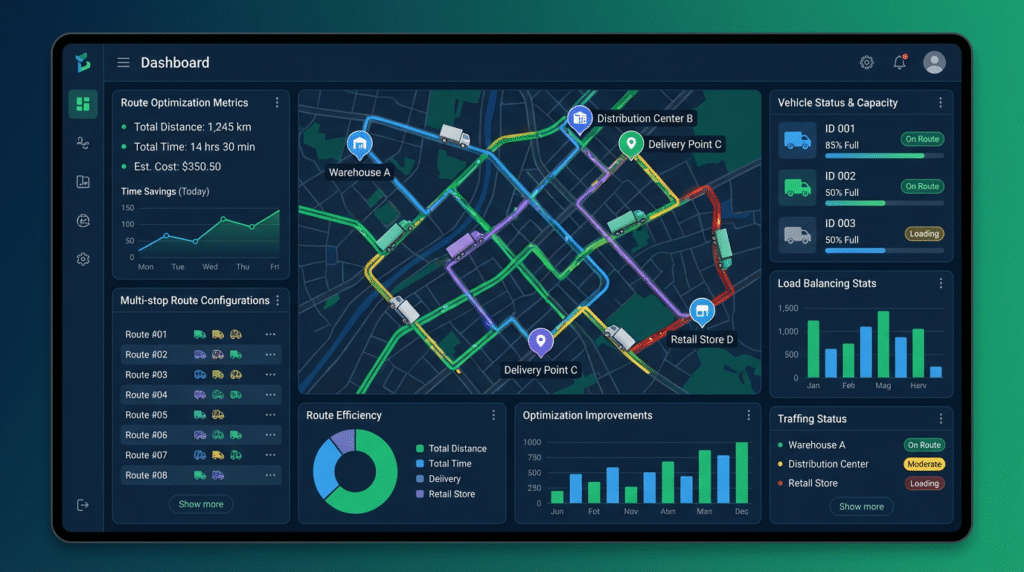
Microservice isolation ensures the routing engine can scale independently using high-performance compute resources like GPU-backed or CPU-optimized clusters.
Warehouse & Inventory Service
For companies operating distribution centers or warehouses, this microservice manages all warehouse workflows and inventory operations. Since warehouses involve scanning at multiple checkpoints and frequent stock movements, this service must be optimized for high-throughput data.
Typical capabilities:
- Inbound/outbound scanning using RFID or barcode devices
- Advanced Shipment Notice (ASN) processing
- Real-time inventory updates across SKUs and storage zones
- BIN, rack, and zone management for optimizing warehouse layout
Separating warehouse operations as a microservice allows logistics platforms to integrate seamlessly with WMS systems or build customized warehouse flows for B2B customers.
Pricing & Billing Service
Logistics billing is complicated due to variable pricing rules across customers, regions, and shipment types. The Pricing & Billing Service centralizes all financial logic so operational changes don’t impact invoicing accuracy.
Its functions include:
- Distance-based and weight-based rate calculations
- Slab-based pricing for enterprise accounts
- Fuel surcharge indexation
- Automated invoice generation and reconciliation
This isolation ensures accurate, compliant billing—even when other services like dispatch or routing undergo frequent updates.
Analytics & Reporting Service
Real-time analytics is crucial for decision-making in B2B logistics—whether monitoring fleet performance, route efficiency, or operational KPIs. Since analytics queries are often heavy and time-consuming, separating them prevents overload on transactional services.
Capabilities include:
- Aggregating historical data for performance reports
- Custom dashboards for enterprise clients
- Predictive analytics for demand, capacity, and maintenance
- Long-running queries without affecting live system performance
By isolating analytics workloads, the main platform remains fast, stable, and responsive.
Benefits for B2B Logistics Stakeholders
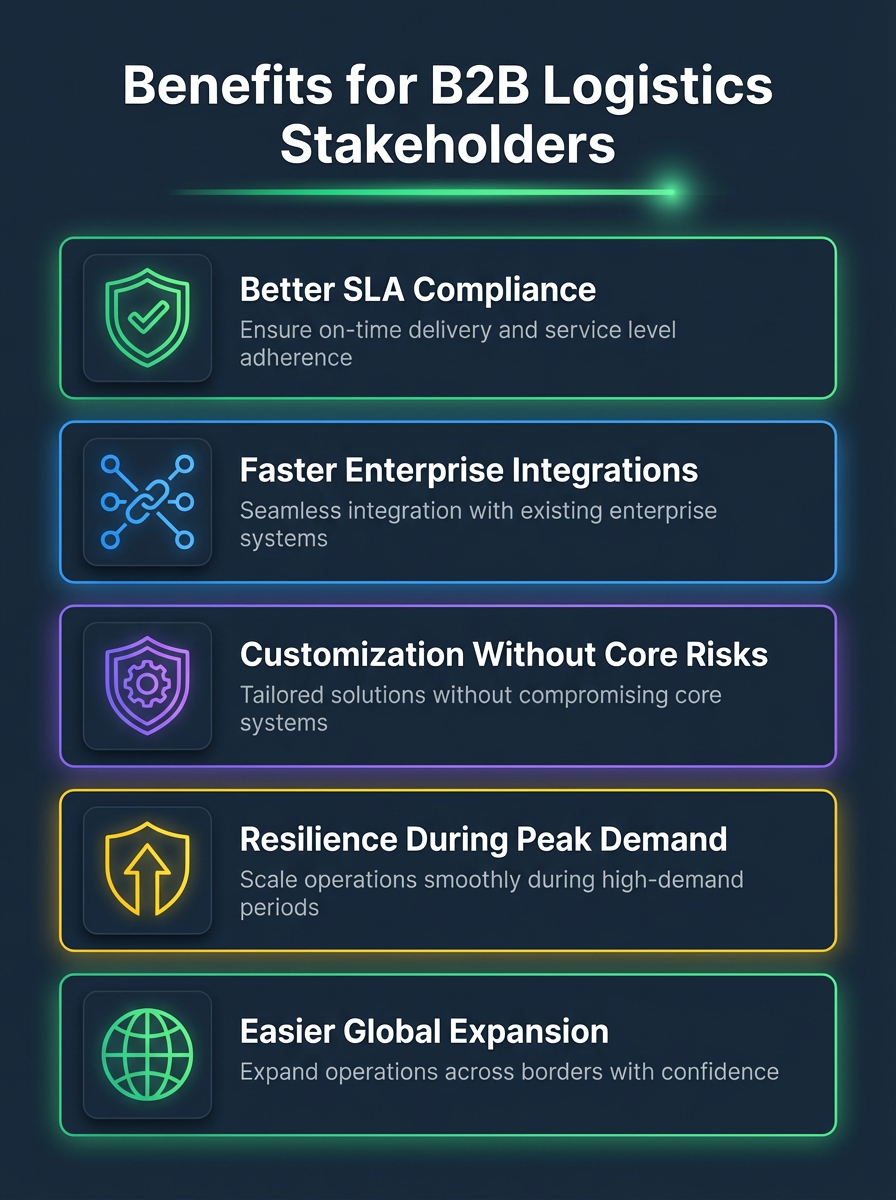
Microservices architecture delivers significant operational and commercial advantages for logistics companies serving enterprise clients. These bene fits go beyond technical improvements—they directly impact SLA performance, integration timelines, customer satisfaction, and the company’s ability to scale globally. Below is an in-depth explanation of each benefit.
1. Better SLA Compliance
For B2B logistics companies, meeting SLAs is non-negotiable. Enterprise customers expect timely pickups, accurate deliveries, and uninterrupted visibility. Microservices play a crucial role here by ensuring that each operational module—tracking, routing, dispatch, billing—runs independently.
2. Faster Enterprise Integrations
Enterprise logistics clients often need custom integrations with their ERP, order management, WMS, or procurement systems. In a monolithic system, every integration touches the core codebase, increasing complexity and slowing down onboarding.
3. Customization Without Core Risks
Large enterprise customers often require customized workflows—special pricing rules, unique approval flows, dedicated reporting dashboards, or region-specific compliance procedures. In a monolithic architecture, adding these customizations risks breaking the main product. Microservices isolate these custom workflows into dedicated services, ensuring they do not interfere with core functionality.
4. Resilience During Peak Demand
Logistics workloads spike during events such as festival seasons, year-end sales, or monthly payroll cycles. Not all services scale equally—tracking may need 10× more processing, while billing might remain stable.
In a microservices architecture, only the services experiencing high demand need to scale. This makes peak readiness more cost-effective and reduces the chance of system failure.
5. Easier Global Expansion
Global logistics operations vary significantly by region—different tax rules, compliance requirements, shipping regulations, and pricing structures. Microservices make expansion easier by allowing teams to create separate services for each region’s logic, without touching core workflows.
This modularity makes it far easier to expand into new markets while keeping the main system stable. It also reduces the time-to-market when launching operations in multiple countries.
When Should a Logistics Company Move to Microservices?
A logistics company—whether operating in freight, warehousing, shipping, or B2B supply-chain software—must eventually face a point where its monolithic system can’t keep up with operational complexity. Microservices become valuable when the business needs speed, reliability, scalability, and flexibility that a single large codebase cannot deliver.
A B2B logistics system should consider migration if:
| Current monolith slows down during peak activity | Development teams are slowed by long deployment cycles |
| Tracking updates lag or drop | Analytics queries impact operational performance |
| Integrations require risky changes in core code | Uptime requirements exceed monolith stability |
Implementation Roadmap for B2B Teams
Transitioning a logistics platform from a monolith to microservices requires a structured, low-risk roadmap. B2B logistics systems are deeply integrated—carriers, warehouses, ERP systems, invoicing, and customer tracking all depend on stable, real-time operations.
Therefore, the roadmap focuses on stability first, then gradual decoupling, and finally scaling microservices independently.
1. Audit the Current System
Before any migration, a company must understand how the existing monolith behaves. An audit reveals where performance slows, which modules create risks, and which areas would benefit the most from microservices. During the audit, focus on the operational hotspots that frequently cause delays.
Tracking Workloads
- Tracking typically handles the highest volume of requests—GPS updates, status changes, carrier pings, and customer queries.
- If this module overloads the monolith, everything slows down.
- Understanding how many updates per second the system handles helps prioritize which services should be decoupled first.
Dispatch Logic
- Dispatching requires complex calculations—driver assignment, route decisions, delivery windows, and vehicle capacity rules.
- In a monolith, these calculations can block other processes and create significant delays.
- Identifying slow rules or heavy algorithms helps plan what to migrate.
Billing Cycles
- Billing and invoicing often run batch jobs that load the system.
- When billing queries run on the same database as tracking or order processing, performance drops.
- Auditing billing helps decide if it needs its own service and database.
API Traffic
- Logistics platforms integrate with many external systems.
- High inbound/outbound API traffic can overwhelm a monolith because all calls route through a single application.
- Measuring real-time API load helps determine where microservices can improve reliability.
2. Build a Strong DevOps Foundation
Before breaking apart the monolith, the team needs a technical foundation that supports fast and safe microservices deployment.
| Automated CI/CD |
- Every service should deploy independently without manual steps.
- CI/CD pipelines reduce release time and prevent deployment errors.
| Containerized Deployments |
- Using Docker and Kubernetes ensures consistent environments.
- Containers make it easier to scale each service based on its load.
| Centralized Logging (ELK, OpenTelemetry) |
- Logs from many services must funnel into a single dashboard.
- Without centralized logs, debugging becomes impossible.
| Distributed Tracing (Jaeger, Zipkin) |
- Microservices communicate constantly.
- Tracing helps identify slow services, failed requests, and network delays in real time.
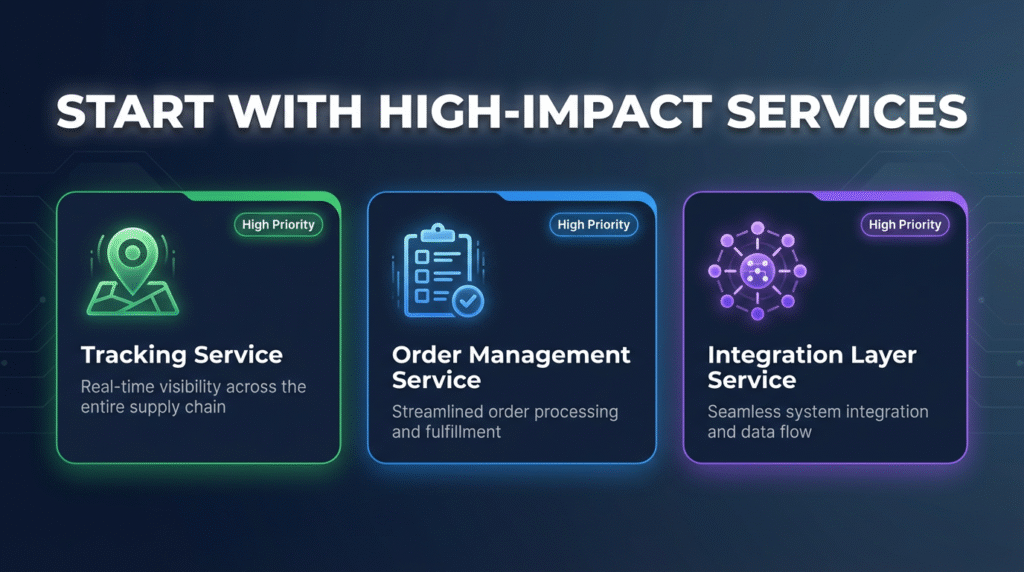
3. Start With High-Impact Services
Not all services need to be extracted immediately, B2B logistics systems should begin with modules that deliver maximum impact with minimum disruption.
Most logistics companies start with:
Tracking Service
- Handles real-time updates and usually carries the highest load.
- Offloading this first improves user experience instantly.
Order Management Service
- Orders drive all downstream processes: routing, billing, status updates.
- Migrating this service stabilizes the operational core.
Integration Layer Service
- External APIs are unpredictable.
- Moving integrations into microservices prevents failures from spreading across the entire system.
4. Gradually Decouple the Monolith
Once the foundation is ready, you begin separating modules one by one by usin the Strangler-Fig Pattern.
This strategy allows the team to:
- extract one service at a time
- redirect traffic to the new service
- slowly “shrink” the monolith
- keep the system running without downtime
5. Prepare for Data Migration
Microservices only work well when each one owns its data. This avoids conflicts, inconsistencies, and cross-service database failures. Data Migration Should Be Planned Using:
| Distributed Tracing (Jaeger, Zipkin) |
| Captures database changes in real time. | Useful when migrating large datasets without downtime. |
| Event Replication |
| Services publish events (e.g., “OrderCreated”), and other services update their own data copies. | This enables predictable data transfer between new and old systems. |
6. Roll Out Incrementally
A successful microservices transition is always step-by-step, never all at once.
How to Roll Out Safely:
- Deploy one microservice at a time
- Monitor performance and error logs
- Slowly increase traffic to the new service
- Ensure fallbacks exist
- Gather feedback from internal teams before full rollout
Incremental rollout reduces risk, prevents disruptions for customers, and allows teams to improve services as they scale.
Conclusion
Microservices are not just a technical upgrade—they’re a strategic enabler for modern logistics businesses. By decomposing complex logistics operations into independent, scalable, event-driven services, companies achieve better uptime, real-time visibility, faster integrations, and the ability to serve demanding enterprise clients.
Scaling a logistics platform is no longer just a technology decision—it’s a business-critical strategy for B2B companies that operate in a fast-moving, integration-heavy, and data-driven environment. As shipment volumes grow, customer expectations tighten, and enterprise clients demand real-time visibility, monolithic systems inevitably hit their limits. Microservices provide a practical, future-ready architecture that supports speed, reliability, and continuous innovation.
By breaking the platform into specialized, independently scalable services, logistics companies gain the flexibility to introduce new features, onboard global partners, maintain uptime during peak seasons, and optimize performance where it matters most—tracking, routing, dispatch, and integrations. This modular approach not only enhances SLA compliance but also empowers product and engineering teams to ship updates faster and with lower operational risk.
The transition requires careful planning: auditing the current system, building a strong DevOps foundation, migrating high-impact services first, and implementing gradual rollout strategies. But once in place, microservices become a competitive advantage—enabling logistics providers to scale confidently, expand into new markets, and support large enterprise clients with customized workflows and near-zero downtime.
For logistics businesses looking to modernize their technology stack and prepare for long-term growth, microservices are not just an architectural upgrade—they are the cornerstone of a scalable, resilient, and globally capable logistics ecosystem.
