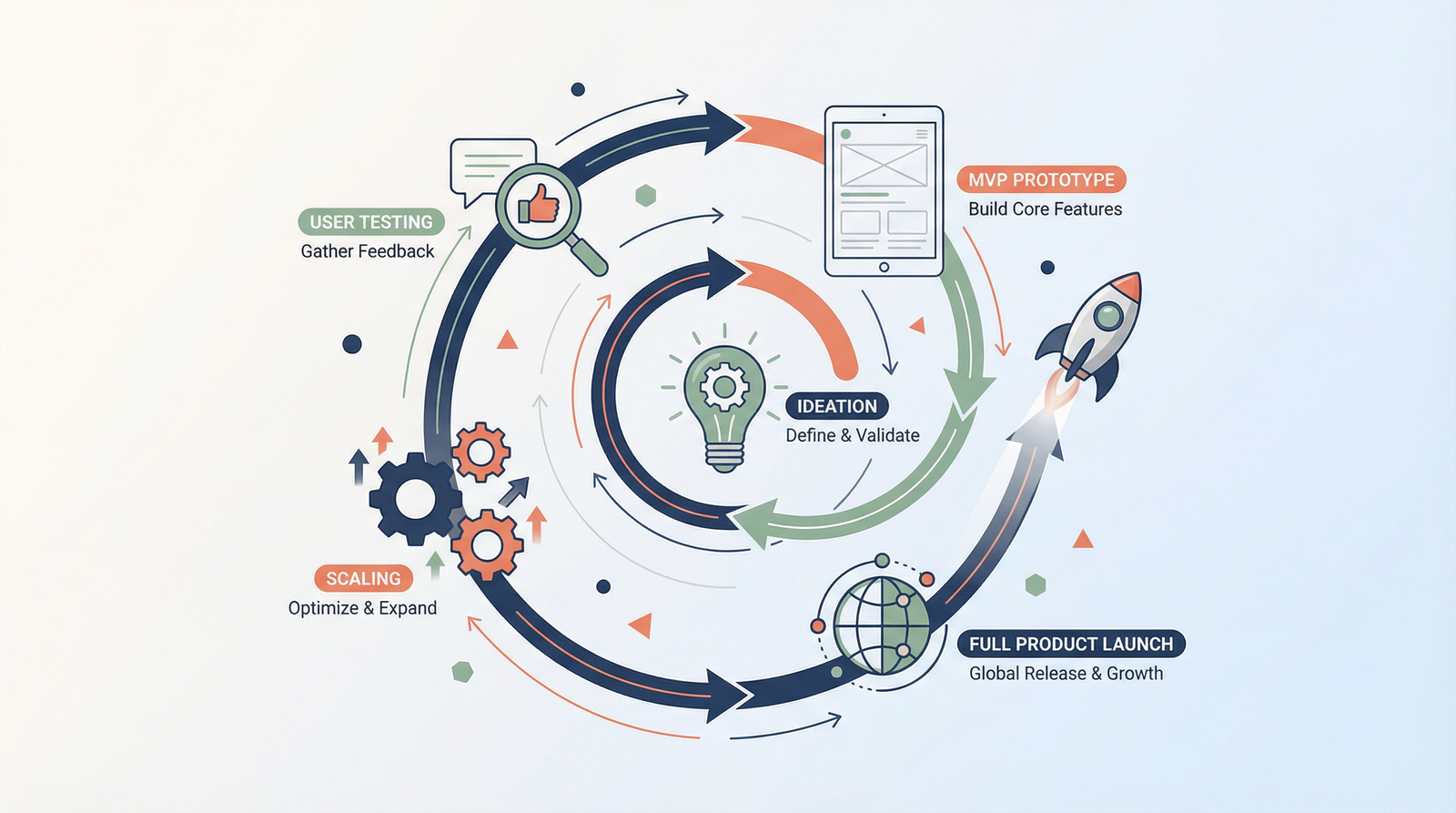
Scaling an MVP is one of the most defining transitions in a startup’s journey. After months of experimenting, validating assumptions, and testing your core value proposition, the early signs of traction begin to show: users keep returning, engagement grows naturally, and you finally see proof that real people benefit from what you’ve built. But this is also the moment when the limitations of an MVP become obvious. What worked for your first hundred users can easily break when thousands join. Processes that were manually handled start slowing down workflows. Features built quickly now feel too basic for serious customers. And the technical shortcuts taken to launch faster begin to create friction, bugs, and bottlenecks.
This is why scaling is not simply a matter of adding more features on top of the MVP. It is a complete transformation of the product—technically, strategically, and operationally. Scaling requires strengthening the foundations you started with, rethinking the architecture, enhancing the user experience, optimizing performance, and building a product that can support long-term growth. It also demands a shift in mindset: instead of focusing only on early validation, you now need to think about stability, reliability, extensibility, and market expansion.
For founders, this phase can feel overwhelming but also incredibly rewarding. It is the stage where your product evolves from a simple experiment into a mature, scalable solution capable of serving large user bases and unlocking new revenue opportunities. In this guide, we will break down the entire journey—how to prepare your MVP for growth, what to fix before scaling, which systems matter most, how to strengthen your team and processes, and what technical and strategic decisions ensure long-term success. This structured, practical roadmap will help you scale with confidence, clarity, and efficiency. This blog walks you through exactly how we scale MVPs into robust products—step by step, backed by real-world patterns and founder-tested strategies.
Why Most MVPs Break When Scaling
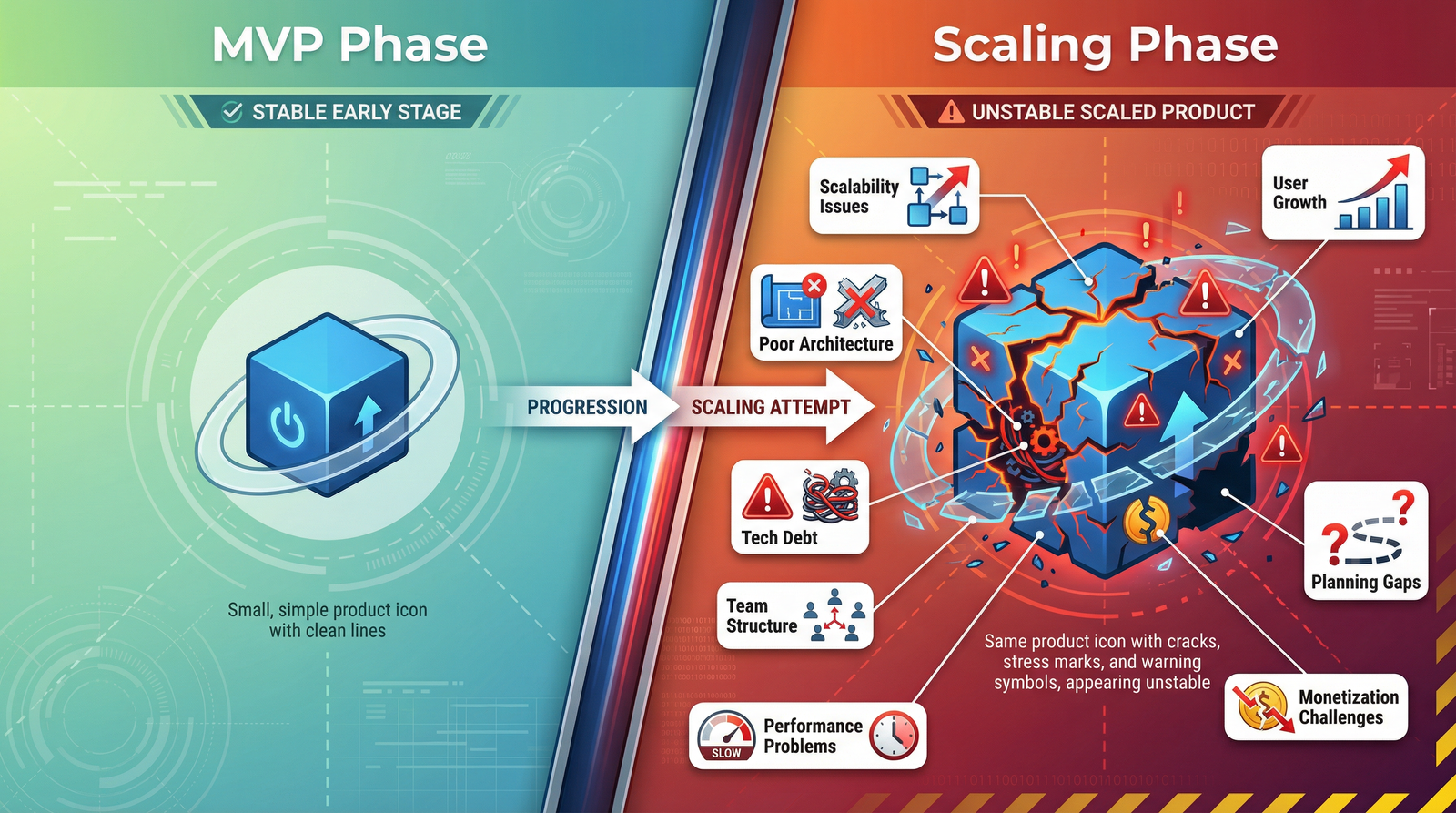
Most MVPs are intentionally built fast, with minimal structure, so founders can test their idea quickly. This approach works perfectly for early validation, but it also creates weaknesses that become visible as soon as the product starts growing. When more users join, workflows become complex, and new requirements emerge, the original MVP foundation often struggles to keep up. What worked for your first 50–200 users is usually not enough for your first 1,000 or 10,000.
The core reason MVPs break is that they are not designed for long-term durability. The focus during MVP development is speed, not scalability. Founders want results quickly, so the product is built using shortcuts—simple database structures, limited automation, basic UI, and minimal error handling. These shortcuts are acceptable at the beginning because the goal is to validate learning, not to build a perfect system. But once the product gains traction, these quick fixes become barriers, slowing down performance, reducing stability, and increasing technical debt.
To scale properly, founders must understand that the MVP is only the beginning, not the final product. It is a testing ground that helps validate demand. Once the demand is clear, the product needs stronger architecture, better user experience, more automation, and a structured approach to growth. Recognizing the limitations of an MVP is the first step to building a product that can serve thousands of users reliably.
Key Features:
| MVPs are built quickly, not carefully. | Architecture is basic and not designed for high load. |
| Security is basic and not ready for sensitive or large-scale data. | UX is minimal and not optimized for complex workflows. |
| Databases are simple and lack proper indexing or structure. | Manual operations become impossible as users increase. |
| Automation, AI, and integrations are missing or very limited. | Analytics and growth systems are too shallow for scaling decisions |
| Growing customer segments create needs the MVP can’t handle. | Adding new features often breaks old ones due to messy code. |
Step 1: Validate That You’re Truly Ready to Scale
Before you begin investing in architecture, new features, or team expansion, you need absolute clarity that your product is genuinely ready for scaling. Many founders rush into this stage because they feel early excitement or pressure from investors—but scaling too early is one of the most common reasons startups stall. The smartest way to grow is to first evaluate whether the MVP has strong, undeniable signals of traction. When these signals are present, you’re not guessing anymore—you’re responding to real market demand. This step protects you from wasting resources and ensures every improvement directly supports growth.
Proven User Demand
The strongest confirmation of readiness is real, observable user behavior—not opinions, not assumptions. When users return to your product without reminders, it means they find genuine value in what you’ve built. If they consistently complete your core value loop—whether it’s ordering, posting, saving, tracking, booking, or creating something—that’s clear evidence the solution works. Referrals make this even stronger; people only recommend products that they trust and find useful. Payment is the ultimate signal, because users rarely spend money on something that doesn’t solve a real problem.
These behaviors prove your core hypothesis: users want what you’re offering. At this point, you’re no longer validating demand—you’re supporting it. That’s the perfect moment to scale.
Bottlenecks Are Obvious
One of the most reliable signs that you’re ready to scale is when the MVP starts breaking under real usage pressure. Too much support load, repeated user complaints, manual processes that no longer work, system slowdowns, or frequent crashes—these are friction points that show your product has outgrown its initial quick-build structure. When feature requests increase rapidly, it means users are relying on the product enough to want more from it.
These issues aren’t setbacks—they’re milestones. They show that your product is being pushed beyond the boundaries of an MVP, and that users want more than what the current system can support. Visible bottlenecks tell you exactly where to invest your next development cycles so the product can grow safely and sustainably.
Monetization Path
Scaling requires time, money, and team resources. Even if you haven’t fully launched your pricing model or aren’t earning major revenue yet, you still need clarity on how value will eventually convert into revenue. You should know which user segments are most willing to pay, why they pay, and what outcomes they get from your product. This prevents you from scaling a product that grows user numbers but drains cash.
A clear monetization path ensures that each scaling decision—whether it’s building new features, improving infrastructure, or expanding the team—adds long-term business value. When your revenue potential aligns with user need, scaling becomes not just feasible, but profitable.
Step 2: The Foundation
Before you scale, you must strengthen the base. Founders often want to jump directly into new features, bigger teams, and growth campaigns—but scaling a messy MVP is like building a skyscraper on a trailer foundation. It might stand for a while, but it won’t survive real pressure.
A scaling-ready product isn’t just “feature-rich”; it’s clean, stable, predictable, and prepared for growth. This is why the first real step after early traction is to clean up the MVP’s technical and product foundation. The goal is simple: remove fragility before adding complexity.
Below are the four major areas every startup should address before expanding their product.
Code Refactoring
MVPs are designed for speed, not elegance. In the rush to validate an idea, the code often becomes:
- duplicated across multiple files
- disorganized or tightly coupled
- undocumented and confusing
- dependent on one developer’s personal style
- missing test coverage
- filled with quick hacks and temporary shortcuts
Refactoring solves these issues by restructuring the code without changing external behavior. It’s not writing new features; it’s improving how the current features work internally.
Key Features Of Refactoring
- Breaking oversized files into smaller, logical modules
- Improving naming conventions, code readability, and logic flow
- Removing dead code, temporary hacks, and outdated experimental logic
- Standardizing coding patterns across the team
- Adding documentation for future developers
- Introducing basic unit tests for critical functions
A clean codebase accelerates everything—new features, bug fixes, onboarding developers, performance improvements, and architecture upgrades. What takes 10 hours in a messy MVP can take 1 hour in a well-structured codebase. This investment multiplies your development speed long-term. In scaling, speed doesn’t come from writing code faster. It comes from making the code easier to work with.
Improve System Architecture
Most MVPs start as monoliths—everything bundled together in a single application. This is perfectly fine for testing an idea. But as users grow, the system begins to feel the pressure. You start seeing slow response times, increased errors, complex dependencies, and difficulty adding new features without breaking existing ones.
At this stage, the architecture needs an upgrade—not a full rewrite, but an intentional redesign to make the product robust.
- Modular Architecture
Separate your application into well-defined modules such as auth, payments, notifications, analytics, etc. - Services Separation
Not full microservices, but logical boundaries that reduce interdependencies and simplify debugging. - Reusable Components
Shared UI blocks, standardized API helpers, and common utility functions prevent duplication. - Scalable Data Storage
Move to databases and structures capable of handling large volumes, indexes, and real-time queries. - Event-Driven Processes
Email sending, report generation, file processing, and third-party syncing should move to background jobs and queues.
A good architecture prevents technical debt from exploding as the product grows. It ensures consistent performance, reduces unexpected failures, and makes future development smoother. Without this foundation, scaling becomes unstable, expensive, and slow.
Stabilize the Core Feature
Every successful product has one primary loop—a core action that delivers value to users. If this loop is unreliable or slow, scaling will amplify the problem. Adding features on top of a shaky foundation will only dilute focus and frustrate users. Before anything else, the core feature must be rock solid.
Users do not stay for features—they stay for value. If the core loop doesn’t consistently deliver that value, scaling efforts become meaningless. Even if users increase temporarily, poor core performance will immediately cause churn, complaints, and bad referrals. The core must be perfected before any expansion.
Step 3: Rearchitecting for Scale
Once the MVP foundation is clean and stable, the next phase is technical evolution—transforming your early-stage architecture into something that can handle thousands (or millions) of users without collapsing. This is where most startups either break or break through.
Rearchitecting doesn’t mean rewriting everything from scratch. It means evolving your system in a controlled, efficient, and scalable way. The goal is to make the product faster, more modular, more stable, and more predictable as load increases.
Move Toward a Modular or Service-Oriented Architecture
Many founders think “scaling architecture” means microservices, but that’s a myth. Full microservices are expensive, complex, and often unnecessary too early. What you need instead is modularization: breaking your application into clean, independent modules that can grow without stepping on each other.
Instead of one gigantic codebase where everything is intertwined, you reorganize it so each major function has its own module. These modules communicate clearly, but they don’t depend on each other’s internal logic.
Benefits of Modularization are:
- Independent deployment
Teams can deploy improvements to one module without affecting the rest. - Clearer ownership
Each module becomes a responsibility zone for specific developers or teams. - Easier debugging
Problems are isolated, not spread through the whole system. - Safer scaling
High-traffic features can be optimized without impacting the entire product.
This approach delivers 80% of the benefits of microservices with 20% of the complexity. It is the most practical path for startups moving from MVP to real product.
Implement Caching for Speed
Caching is one of the simplest but highest-impact changes you can make for scalability. Instead of recalculating or refetching data every time, your system temporarily stores frequently used data so it can load instantly. When used correctly, caching can reduce response times by 80–90%.
Common caching layers include:
- In-memory caching (Redis)
Stores frequently accessed data in memory for lightning-fast retrieval. - API response caching
Reuses responses for repeated requests instead of regenerating them. - Database query caching
Speeds up heavy queries that run often. - CDN caching
Speeds up images, scripts, videos, and static assets globally.
Strengthen Your Deployment Pipeline (CI/CD)
In the MVP stage, deployments are often manual, risky, and fragile. Developers push code directly to the server, fix things in production, and pray nothing breaks. This works temporarily, but at scale it becomes a disaster. A strong CI/CD pipeline ensures your team can deploy fast and safely.
scalable deployment pipeline includes:
- Automated testing
Ensures each update doesn’t break existing functions. - Automated deployment
Code moves from development → staging → production without manual steps. - Staging environments
A safe space to test new features before sending them live. - Rollback systems
If something breaks, you can immediately revert to the previous stable version.
Step 4: Product Expansion
Once your foundation is strong—clean architecture, stable core features, automation, performance optimizations—you’re finally ready to expand. But here’s the truth: adding features too fast is one of the most common ways growing startups destroy momentum.
Most founders add features based on intuition, competition, personal excitement, or investor pressure. But successful scaling requires discipline, data, and user-centered prioritization. This step is all about expanding in a way that deepens value, strengthens your product position, and avoids unnecessary complexity.
Build a Feature Roadmap Driven by Real User Behavior
At scale, “gut feeling” is not enough. Your product decisions must come from evidence, not assumption. The best products grow by deeply understanding how users actually behave, not how founders expect them to behave.
A data-driven roadmap ensures:
- You build what people truly want
- You reduce wasted development effort
- You target the biggest value gaps
- You enhance product-market fit continuously
Prioritize the Right Types of Features (In the Right Order)
Not all features are equal. Some strengthen the product. Some differentiate you in the market. Some expand your reach, and some drive revenue. Scaling means adding them strategically, not all at once.
If you introduce expansion or revenue features before fixing the core, the product becomes bloated and confusing. Users stop understanding what your product is “best at.”
The formula is simple:
First perfect the core → then differentiate → then expand → then monetize.
That’s how you scale cleanly without losing direction.
Create a Design System — Scale UX Without Chaos
As the product grows, inconsistencies multiply. Buttons, fonts, spacing, colors, interactions—they all start to drift when multiple people design and develop independently. A design system is the antidote. It’s a unified set of rules and components that ensure the entire product looks and behaves consistently across:
- Web app
- Mobile app
- Admin dashboards
- Email templates
- Marketing site
- Internal back-office tools
A design system is a force multiplier. It turns product development into a predictable, repeatable workflow instead of a creative free-for-all.
Step 5: Scaling the Team
A scalable product requires a scalable team. In the MVP stage, founders often do everything—coding, designing, testing, support, marketing, even deployment. This works until early traction hits, and suddenly the founder becomes the bottleneck. Scaling means building a focused, aligned, and structured product team that can ship fast without chaos.
Define Clear Product & Engineering Roles
You don’t need a 20-person team to scale effectively. You need clarity, not size. The moment you start scaling, responsibilities must be assigned deliberately.
Essential early-scale roles include:
- Product Manager – defines features, requirements, and user needs
- Tech Lead – owns architecture, technical decisions, code quality
- Backend Engineer – builds APIs, logic, integrations, database systems
- Frontend Engineer – builds UI components, web/mobile interfaces
- QA Engineer – owns testing, stability, and quality
- UI/UX Designer – creates design systems, UX flows, interface designs
- Growth Marketer – handles analytics, funnels, activation, and retention
Implement QA Processes
In the MVP stage, bugs are tolerated. Users understand the product is new. But once you scale, expectations change. Bugs directly impact retention, trust, and revenue. That’s why QA becomes a pillar of scaling.
Key QA processes include:
- Test plans – documented test scenarios
- Regression testing – checking all old features whenever something new is added
- Automated testing – covering core flows
- UAT cycles (User Acceptance Testing) – ensuring real users validate the feature
- Bug reporting and prioritization structure – so nothing falls through the cracks