Building an MVP in 2025 is no longer about launching a bare-bones version of your idea. The market has changed. User expectations have evolved. Even the smallest SaaS product is expected to be intelligent, fast, personalized, and capable of saving users time. Simply offering forms, dashboards, and manual workflows is no longer enough. In almost every product category—from logistics to real estate to HR, finance, and e-commerce—the apps that win are the ones that help people think less and achieve more.
This shift did not come from better UI design or faster development tools; it came from one major advancement: AI APIs. These ready-to-use interfaces let developers add intelligence to their apps in minutes—without hiring data scientists or training models. Over the past two years, I’ve worked on multiple AI-enabled MVPs for different industries, and I’ve seen the same pattern repeat again and again: a small, simple app becomes 3x more useful the moment you add AI APIs to process data, automate tasks, interpret inputs, and guide users.
Steve Jobs once said:
“Start small, think big. Don’t worry about too many things at once.”
But despite this opportunity, most new founders still don’t understand what AI APIs actually do, how they fit into an MVP, and how they can be integrated without blowing up development costs or timelines. This blog explains all of that—from real experience—not theory. Instead of overwhelming you with dozens of headings, I will walk you through the journey of creating an AI-powered MVP from scratch, showing why intelligence matters, where it fits, and how I’ve seen it transform real-world projects.
Understanding AI APIs
AI APIs are ready-made tools that allow your MVP to use artificial intelligence without building complex models yourself. When your app sends data to an AI API—such as text, an image, or a question—it returns a smart response. This makes it easy for any startup to add intelligence, reasoning, and automation to their product with just a few lines of code.
For early-stage teams, the biggest advantage of AI APIs is speed. Instead of spending months training models, gathering datasets, and setting up servers, you simply connect to an API and get instant access to advanced AI features. It removes the need for data science expertise and keeps development costs low, which helps founders focus on solving the real user problem.
Inside an MVP, AI APIs can understand language, analyze content, make decisions, personalize user experiences, and predict future behavior. These abilities help your product feel interactive and intelligent from day one. Even small teams can build features that used to require large engineering departments, because the “intelligence layer” is already done for you.
There are many types of AI APIs available—language models, vision APIs, speech APIs, and prediction APIs—each designed for specific tasks. Founders can mix and match these capabilities depending on what their MVP needs. This flexibility makes AI APIs one of the fastest and most effective ways to build smarter, more powerful products without increasing complexity.
Why MVPs Need To Be Smart Today
A few years ago, users were patient. They accepted MVPs that were buggy, slow, or limited in functionality as long as they solved one problem reasonably well. Today the situation is very different. People are surrounded by intelligent experiences everywhere—AI in their chat tools, AI in their phones, AI recommending content, AI summarizing long texts, and AI writing their emails. When they try a new product, they subconsciously expect it to be smart, too.
This means that the definition of “minimum viable” has changed. An MVP that simply stores data is not enough. Users don’t want a tool that gives them more work—they want a tool that reduces work. They want apps that can understand what they write, anticipate what they need, and automate routine decisions.
Founders often worry that “smart features” will be expensive or technically complicated. But modern AI APIs completely remove those barriers. You no longer need machine learning expertise; you just call an API the same way you integrate a payment gateway or SMS service. This is why the smartest modern MVPs look polished even when the team behind them is small.
What AI APIs Actually Do
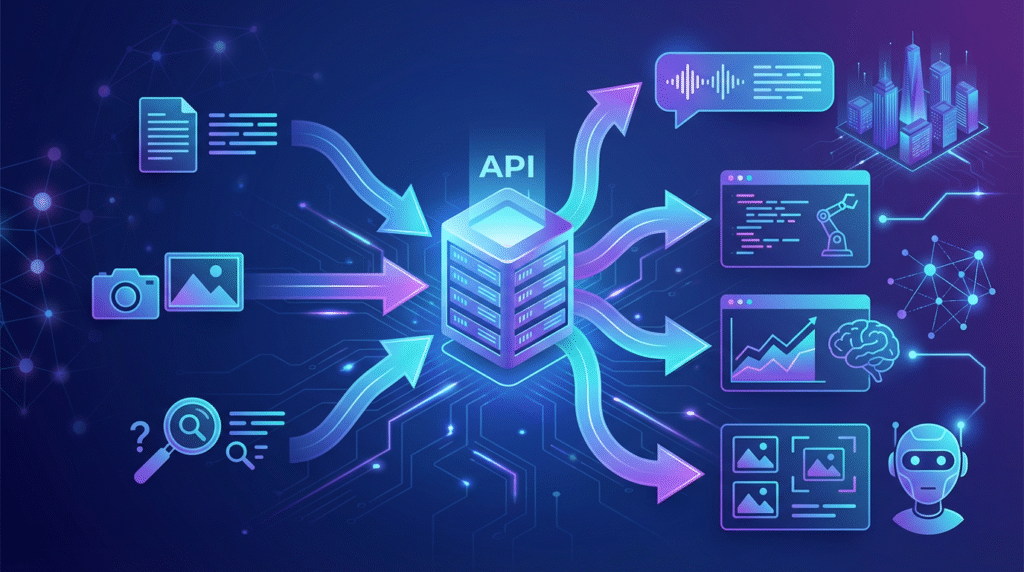
To understand why AI APIs multiply MVP value, it helps to see them for what they really are: ready-made intelligence modules. You send them a piece of text, an image, a document, or audio, and they return something meaningful—an analysis, a summary, a classification, a recommendation, or an action plan.
The magic is not in complexity; it’s in how easily this intelligence can be inserted into normal app workflows. AI APIs can:
- Analyze user input and understand intent
- Convert messy unstructured data into clean structured formats
- Generate content such as emails, summaries, insights, and reports
- Create recommendations based on user behavior
- Extract key fields from PDFs or images
- Automate multi-step workflows
- Act as conversational assistants inside your product
When you combine this intelligence with a simple product, the result feels far beyond a traditional MVP. From the user’s perspective, it feels like the app understands them rather than forcing them to do more work.
How AI Makes MVPs Feel 3x Smarter
The smartest integrations I’ve done across various projects all fall into three categories: understanding, decision-making, and automation.
Understanding means the app can interpret user behavior, unstructured text, images, or uploaded files and extract meaning without manual tagging. When a logistics driver writes a rough message full of spelling mistakes, the AI understands that it refers to a delayed shipment. When a real estate agent uploads a voice note, the AI extracts the client’s requirements.
Decision-making means the app can choose what to do next—assign a task, score a lead, recommend a workflow, highlight a priority, or classify a request. The product starts to feel like it’s thinking.
Automation means the app actually performs useful tasks by itself: drafting emails, preparing reports, updating spreadsheets, classifying issues, generating summaries, or completing repetitive workflows.
When you add these three capabilities to even a small MVP, users instantly feel the difference. They no longer see it as a basic tool—they see it as a partner. And that emotional shift is what makes AI-enabled MVPs so powerful.
Real-Time Projects Where AI Transformed MVPs
Over the past two years, I’ve seen this happen repeatedly in real-world projects. These examples are not theoretical—they come directly from actual MVPs I helped build.
In a logistics operations app, drivers often sent updates in random formats—voice notes, vague messages, broken English, or shorthand sentences like “delayed gate issue.” Before AI, a human had to read these and manually update the system. By integrating an AI API, the app now extracts the shipment ID, delay reason, expected new delivery time, and assigns a delay category automatically. Managers receive a clean, structured report without reading dozens of messages. The daily time saved was so significant that the feature instantly became the highlight of the MVP.
In a real estate CRM, agents struggled with follow-ups. They were overwhelmed, busy, and not good at consistent emailing. After integrating an AI email generator trained on each client’s conversation history, the system now creates perfect follow-up messages in seconds. Agents simply review and press send. This completely changed the perceived value of the CRM. It went from “a place to store leads” to “a tool that helps me close deals.”
In a content planning tool, users needed help with keyword research, metadata creation, and content structure. Instead of building large dashboards, I integrated AI APIs that understand the user’s niche, generate SEO keywords, cluster them by intent, and prepare outlines automatically. The result was a dramatic increase in engagement because users immediately felt supported rather than overwhelmed.
In an HR applicant screening MVP, reviewing resumes used to take hours. The AI now extracts the candidate’s skills, academic background, experience level, and matches them to the job description. It then produces a short summary and assigns a match score. The shift was enormous: founders who thought they needed a full HR team suddenly realized that AI could screen dozens of CVs in minutes.
These kinds of transformations show why AI APIs are becoming core components of modern MVPs. They take the heavy lifting out of user workflows and deliver instant functional impact.
How AI Fits Into MVP Architecture Without Complexity
Most founders assume AI requires special backend architecture or heavy computing infrastructure. In reality, the integration is extremely simple. You build your normal backend using Node.js, Laravel, Django, or any framework you like. Then, whenever an intelligent action is needed, the backend briefly connects to an AI API, sends data, and receives intelligent output.
The entire flow can be as:
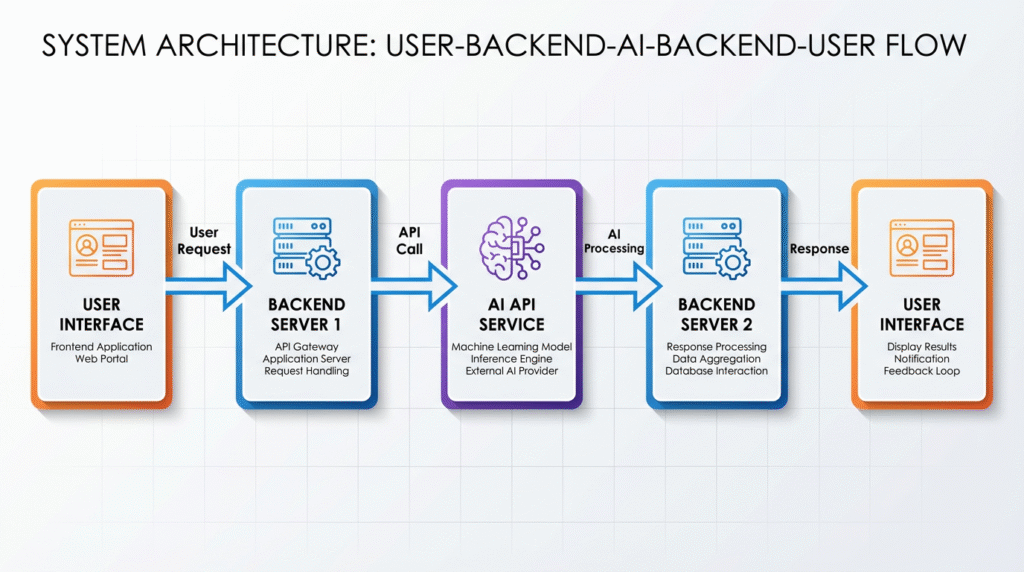
If the user writes a message, uploads a document, or requests something complex, the backend sends the raw data to the AI API, receives a structured interpretation or generated content, and returns it to the frontend. That’s it.
- You don’t need GPUs.
- You don’t need to host models.
- You don’t need data scientists.
- All you need is clean logic around when to call the AI and how to format prompts.
Where You Should Integrate AI Inside an MVP
Instead of putting AI everywhere, the best results come from placing it in areas where users already struggle. The most impactful spots are onboarding, search, recommendations, data entry, workflow automation, and content creation.
For example, intelligent onboarding makes the first-time experience smooth. If you ask a user, “What kind of work do you manage?”, the AI can convert their answer into pre-built templates, settings, or workflows. Instead of forcing them to set everything manually, the app does it for them.
Search becomes dramatically better when powered by AI. Instead of matching keywords, the app understands meaning. A user might write “Where is the file where Bilal asked for new banners?” and the AI finds it—even if the actual message didn’t contain those exact words.
AI can also extract structured data from images and PDFs, which is priceless in industries like logistics, HR, finance, and legal operations. Instead of typing fields manually, the AI reads documents and fills the database.
Personalization is another area where AI shines. If users behave differently, the AI can suggest tasks, content, or recommendations based on their patterns rather than generic defaults.
When these smart layers combine, the MVP becomes far more than a basic tool—it becomes an assistant.
Choosing Which AI APIs to Use
There isn’t one perfect API for everything. OpenAI, Gemini, and Bedrock each have strengths. Agents and reasoning tasks often work best on OpenAI. Document-heavy apps work well with Gemini. Secure enterprise integrations lean toward Bedrock. For vector search, Pinecone excels. For transcription, AssemblyAI is highly accurate.
The key is choosing the right tool for the right job instead of forcing everything into one model. When selecting APIs, I consider intelligence, cost efficiency, speed, and how well the outputs align with the product’s workflow.
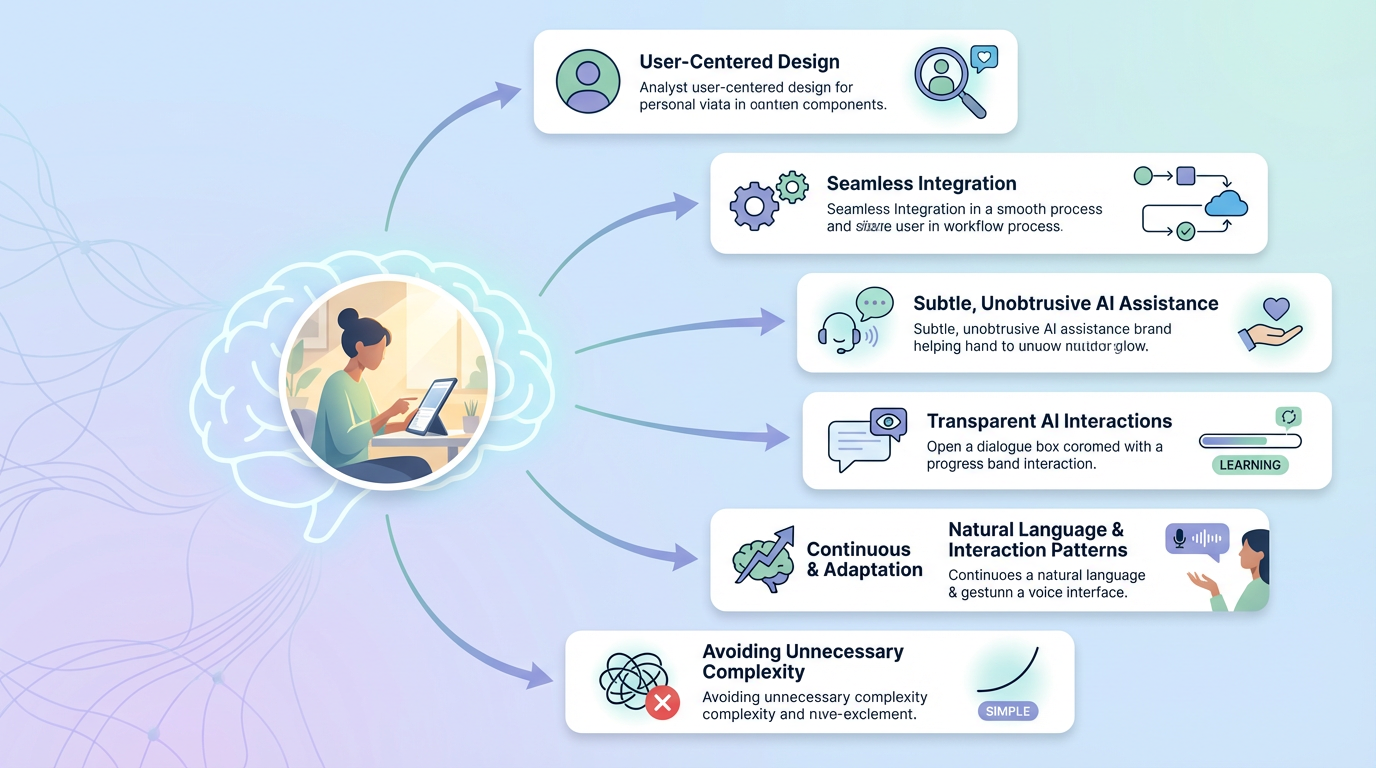
How to Design AI Features That Feel Natural, Not Gimmicky
Bad AI integration can ruin an MVP. Many founders fall into the trap of adding flashy AI features that users don’t actually need. The secret is designing AI around real pain points. A follow-up email generator solves a real problem. But a random AI chatbot in a screen where users just want simple navigation can feel awkward.
AI should reduce effort, not add more steps.
Also, users must feel in control. Instead of letting AI make blind decisions, the app should always show output that users can approve, edit, or decline. This builds trust.
Prompts should be hidden. Users should not have to describe what they want in detail. Instead, the app should intelligently collect context and apply AI automatically.
When AI contributes quietly in the background, the product feels polished and professional instead of experimental.
Mistakes Founders Commonly Make When Adding AI
One of the biggest mistakes is overusing advanced models. You don’t need the most expensive GPT model for every action. Simple classification tasks should use smaller models. Otherwise, costs increase unnecessarily.
Another problem is relying too heavily on AI for core logic. Some decisions should remain deterministic and rule-based. AI’s unpredictability can create inconsistent user experiences if not handled carefully.
Founders also underestimate the importance of preparing the right context. AI outputs depend heavily on what information you provide. If the product does not gather enough user data or conversation history, the AI becomes generic and less helpful.
Privacy is another area people forget. If your app handles sensitive data, selecting the right API provider matters.
Managing AI Costs in an MVP
AI can be inexpensive if used wisely. Most founders overspend because they use large models, send unnecessarily long prompts, or generate responses repeatedly instead of caching results.
One effective method is batching—sending multiple items in one request. Another is pre-processing inputs to shorten them before sending to the API. Caching frequently requested outputs reduces cost dramatically.
With these strategies, even AI-heavy MVPs can operate affordably.
Why AI-Native MVPs Are the Future
As AI continues to evolve, products that use it intelligently will outperform those that don’t. AI-native MVPs are faster to build, more engaging for users, and immediately feel like premium solutions. They automate work, save time, and create more value from day one.
Founders who build AI-enhanced products don’t just create software—they create systems that think, support, and assist users. This is exactly what modern customers want.
The difference between a traditional MVP and an AI-native MVP is the difference between a tool and a teammate. And once users experience the latter, they do not want to go back.

Final Thoughts
AI APIs have completely reshaped how modern MVPs are built. What once required large engineering teams, specialized data scientists, and months of experimentation can now be accomplished with a simple API call. This shift has allowed startups to focus more on the core problem they are solving rather than the heavy technical work happening behind the scenes. By relying on AI APIs, founders gain immediate access to world-class intelligence—language understanding, content generation, prediction, personalization, automation—without needing to create these systems from scratch. This dramatically reduces both development time and cost, making innovation far more accessible for small teams.
The real value of AI APIs is not just convenience but transformation. When you integrate AI into your MVP, the product becomes more interactive and adaptive. It learns from user behavior, responds to complex queries, automates repetitive tasks, and provides insights that traditional software simply couldn’t. This creates deeper engagement, better user satisfaction, and a product experience that feels modern and intelligent. Instead of launching a basic version of your idea, you launch something that appears polished and powerful from day one.
Moreover, AI APIs future-proof your product. As your user base grows, these APIs scale automatically, ensuring consistent performance without additional infrastructure. They also evolve as new AI capabilities emerge, allowing your MVP to upgrade itself over time. This gives startups a long-term advantage: they can grow without constantly rebuilding their tech stack. With AI APIs, even a simple MVP gains the ability to adapt, expand, and improve continuously.
In the near future, AI-powered features will no longer be considered advanced—they will be the standard. Users will expect products to understand them, assist them, and make decisions intelligently. Startups that adopt AI early will naturally stand out, while those who ignore it risk falling behind. Integrating AI APIs into your MVP is not just a smart option; it’s becoming a necessary strategy for staying competitive. When you build with AI from the start, you create a product that is faster to launch, smarter to use, and more impactful in the long run.
