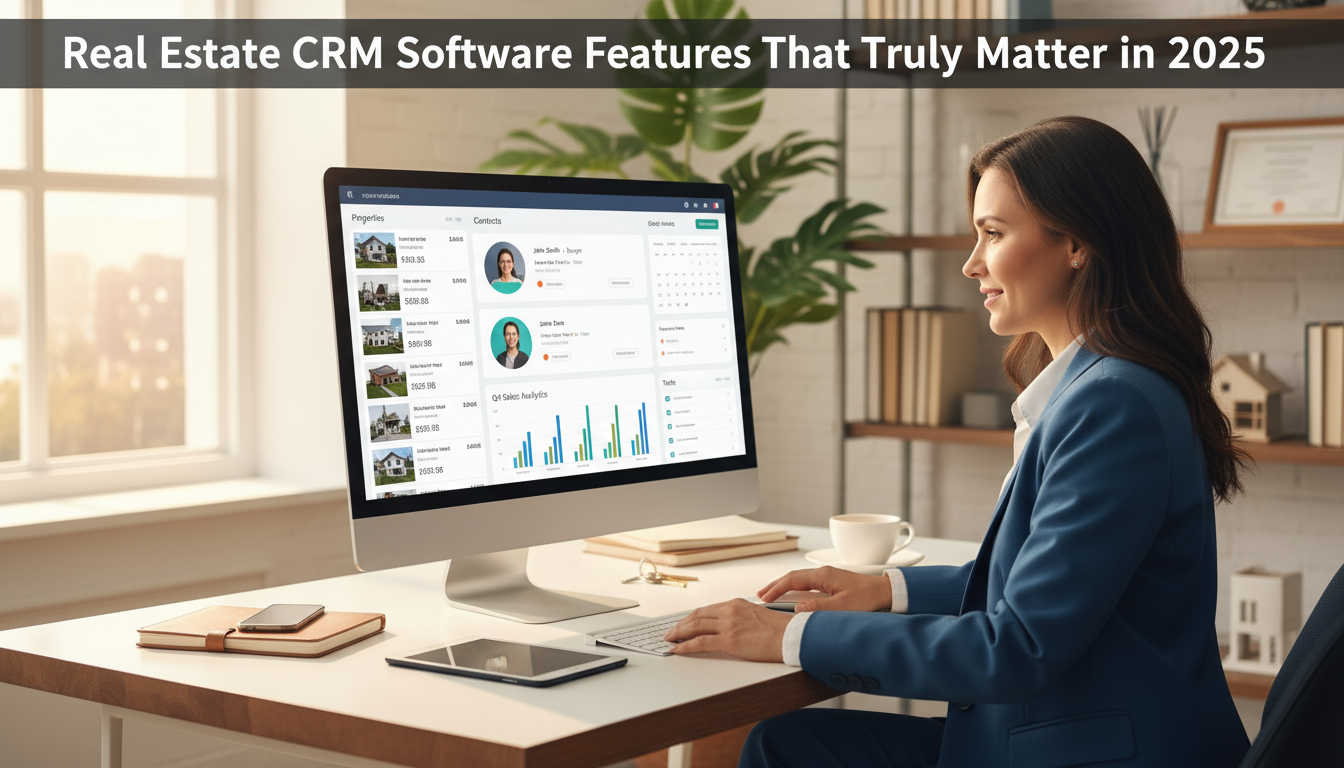
In this world of very fast-growing and highly competitive Real Estate, technology is no longer an option but has become essential. Real estate agents, brokers, and agencies are presently very reliant on software solutions to get the better edge. Among all available tools, Real Estate CRM Software stands out as a game-changer.
Not all CRMs are created equal, and going into 2025, it’s important to understand what features really make a difference in actually enabling the agents to close deals faster, increasing client satisfaction, and smoothing operations.
“Real Estate CRM is much more than just another tool; it is actually the backbone of smarter selling, stronger relationships with clients, and unstoppable growth in the property market.”
Before we dive deep into those features, let’s first explore the foundation: what real estate CRM software really is, and why it’s fast becoming the backbone of each prosperous real estate business.
Understanding Real Estate CRM Software
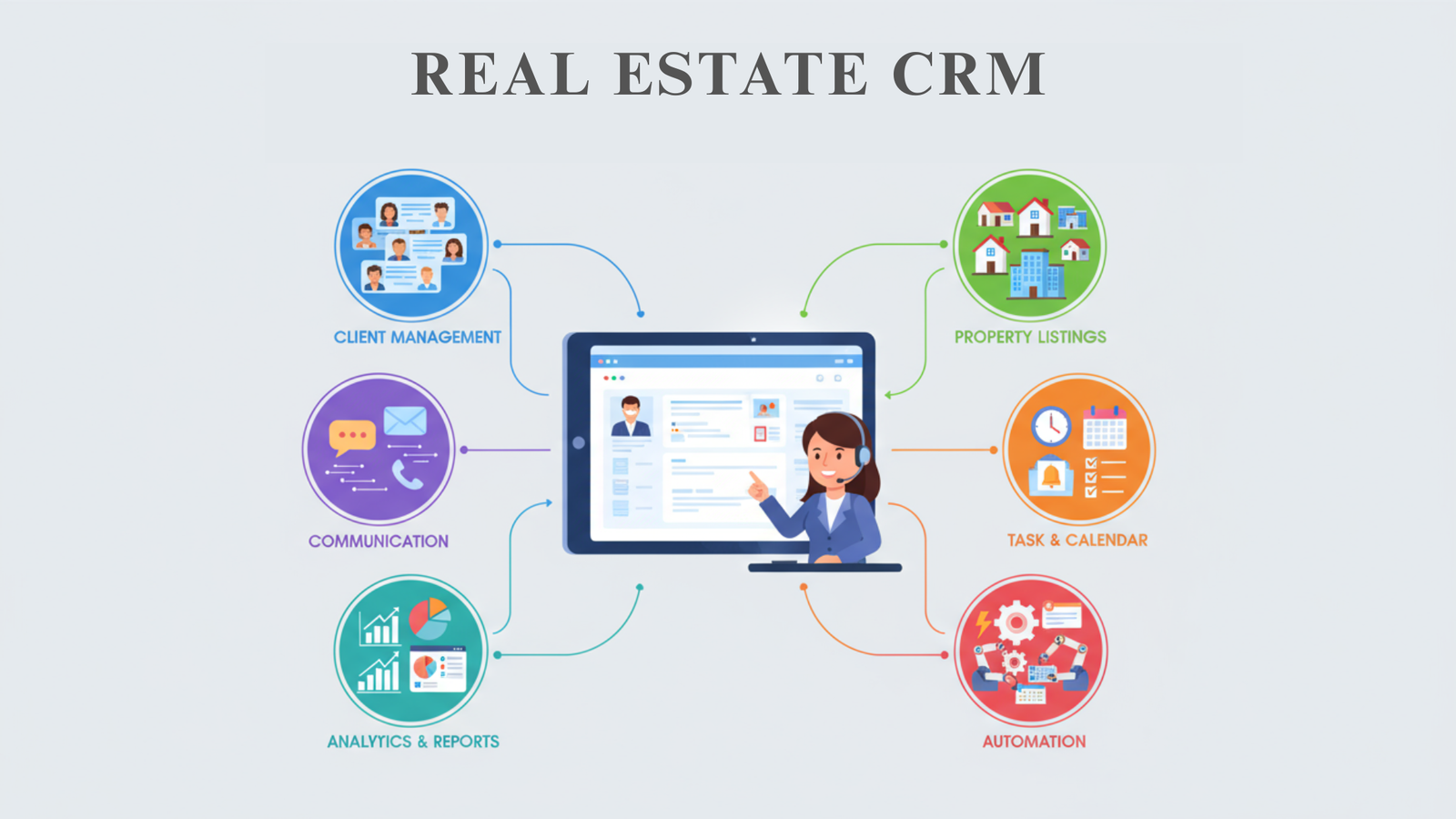
In today’s fast-moving property market, Real Estate CRM software has become an essential tool for agents, brokers, and real estate firms for smoothly managing all aspects of their business operations and keeping up with client relationships. In plain words, Real Estate CRM is a technology platform catering specifically to the real estate industry for managing leads, tracking communication, managing listings, and automating routine tasks-all on one platform.
While a traditional CRM system handles sales management in general, Real Estate CRM software goes beyond that. It’s tailor-made to satisfy the unique demands of property professionals, enabling them to capture inquiries on websites, social media, and listings while keeping in mind client preferences on location, budget, and property type so that they can further nurture leads efficiently and close deals faster. Modern real estate CRMs bring multiple tools together in one place, including email marketing, follow-up reminders, recording client history, a property portfolio, and reporting analytics. By keeping everything in one place, real estate professionals are able to keep very strong relationships with their clients while remaining organized and informed.
Automation is also at the core of these systems. For example, instead of manually typing in each lead or sending the same e-mail several times, this real estate CRM software completes this for you automatically to save you important time. Suppose a potential buyer visits your website and requests information about a property. The CRM immediately logs their information, tags them as a lead, and even sends an automated follow-up message.
As an accomplished real estate consultant would say:
“A CRM isn’t just software-it’s the heartbeat of your business. It keeps your relationships alive, your data organized, and your deals moving.”
Real Estate CRM ( Customer Relationship Management) software increases not only operational efficiency but also customer satisfaction. With accurate, real-time data, agents are able to offer a personalized service that is a major differentiator in today’s competitive housing market. Whether it be remembering a client’s anniversary, sending property updates, or tracking every thread of communication, a CRM helps agents deliver an exceptional experience from first contact to final sale. A fully functional real estate CRM software is ultimately more than just a digital tool but acts as a strategic partner in helping agents gain easier access to their clients.
What Makes Real Estate CRM the Heart of Modern Property Management?
A Real Estate CRM Software is not just a tool to manage contacts. It centralizes many areas of your real estate business, such as managing leads, tracking deals, managing listings, automating communication, and managing client relationships, in one place. In the earlier days of the real estate business, agents followed up on client communications through spreadsheets, notepads, and emails. However, this approach became inefficient as the business became more competitive and data centric.
A real estate CRM software system is a platform that consolidates clearing house consumer data, inquiry data, communications data, property interests data, and transactions data into one platform and then adds automation and analytics to craft a smarter, faster workflow.
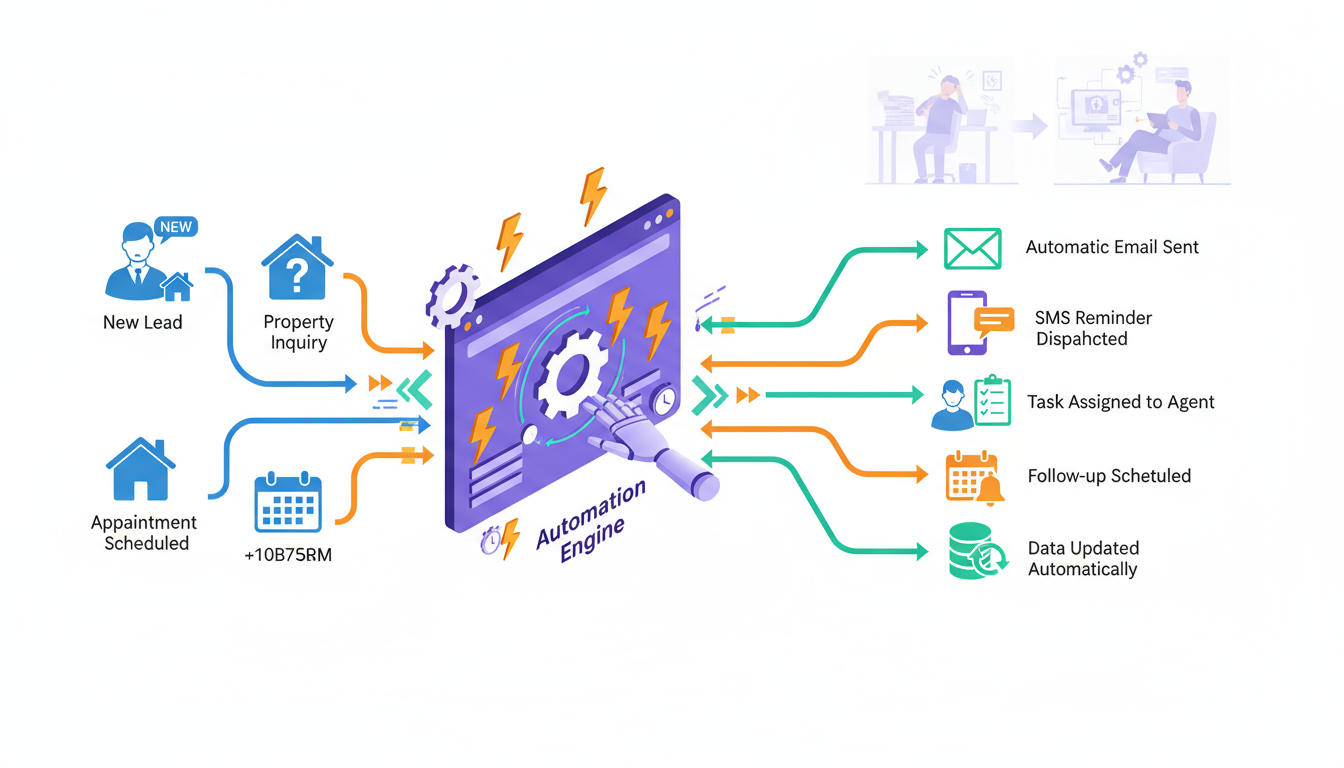
Here’s how it works:
- The CRM automatically captures the details of a new lead that has filled out a form on the website.
- The CRM assigns that lead to an available agent.
- Following, the CRM sends out automated follow-up emails or SMS messages.
- When the first contact is not responded to, in the timeline established by the user, the CRM sends a reminder to the agent to follow-up.
The CRM tracks all of these repetitive but also important steps to ensure opportunities do not slip through the cracks.
Why Every Agent Needs It in 2025
The 2025 real estate CRM software market is fast, digital, and highly client-centric. Buyers expect instant responses, personalized listings, and smooth transactions. Without a CRM, it’s almost impossible to deliver that level of service at scale.
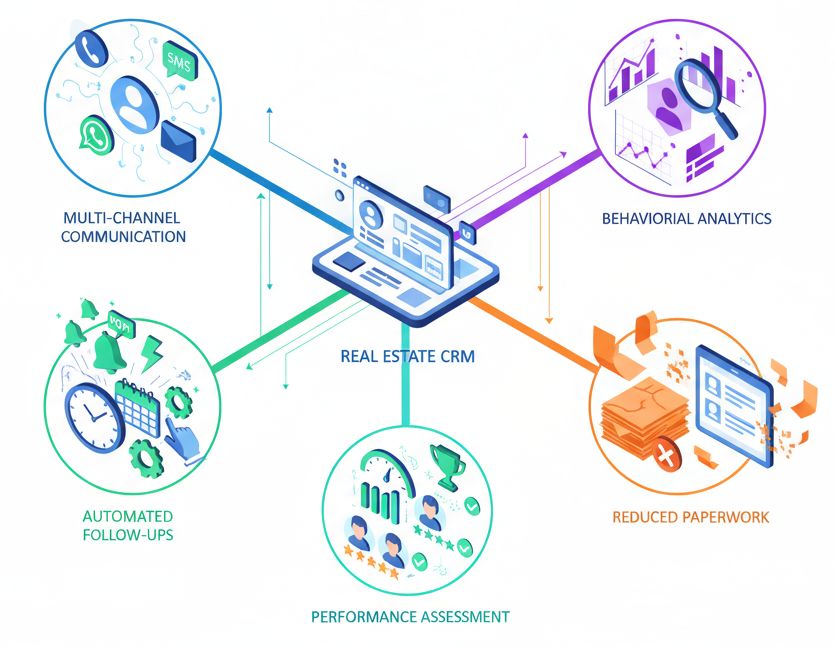
A good real estate CRM allows you to:
- Maintain connections across various channels.
- Gain insight into your clients through behavioral analytics.
- Send automated follow-up and reminders.
- Decrease manual data entry and paperwork.
The Real Estate CRM Features That Truly Matter in 2025
As competition and a thirst for data become increasingly apparent in the real estate market, not all features of a CRM matter. By 2025, agents and brokers have moved beyond superficial solutions that do not really assist in closing more deals faster and building meaningful client relationships. Let’s look at some of the features that define the best real estate CRM software this year.
1. AI-Powered Lead Management
Speed and precision are the hallmarks of success in 2025. AI-driven lead management changes the game for agents in terms of how they treat incoming prospects. Modern CRMs can capture leads from websites, social media, and marketing channels; analyze their behaviors while interacting with the content; and then assess their present intent. Rather than managing dozens of inquiries with little to no context, AI prioritizes leads based on behavioral engagement−such as the number of times clients click and/or open emails or engage with your property pages. If a buyer returned to a handful of listings repeatedly, the lead is flagged as “hot” in the CRM, alerting the assigned agent.
It saves time and prioritizes the best prospects so that the high-quality ones are contacted first. As one real estate CRM software consultant said, “AI doesn’t just organize your leads; it tells you who’s ready to buy.”
By leveraging AI-driven scoring and automation, agents can focus their energy where it truly counts-nurturing serious clients and closing deals faster.
2. Multi-Channel Communication
Today, customers communicate with representatives through many different channels like emails, phone calls, WhatsApp, Facebook Messenger, etc. An all-in-one real estate CRM software combines these channels so that agents can always stay in touch—regardless of what part of the system the client uses.
This implies that all messages, emails, and inquiries are recorded in the CRM, thus building a complete client history that is constantly accessible. Would you be surprised to have the whole communication history of a client right before you-from the very first inquiry email to their last WhatsApp message saying that they are going to the viewing?
“Customers remember how quickly you responded, not how busy you were,” says real estate strategist Liam Henderson.
Unified communication ensures no client ever feels left out. Placing all messages in the same area allows agents to avoid confusion and missed follow-ups and ensure their communication is consistent, professional, and on point across every platform.
3. Workflow and Task Automation
Repetitive tasks act as silent productivity thieves in real estate. Fortunately, automation has enhanced the experience. A modern real estate CRM will automate, follow-ups, appointment reminders, payment notifications, and even thank-you messages to clients: all without requiring manual action.
Sophie Allen, a senior property manager, says
“Automation is not to replace agents, it is meant to amplify their focus.”
For example, when a new lead signs up through your website, the CRM will automatically send a warm welcome email, assign the lead to an agent, and schedule a reminder for subsequent action. Every action occurs behind the scenes for you, allowing your team to move on from the tedious task of manual work.
4. Data Analytics and Performance Tracking
In 2025, success in real estate isn’t based on intuition; it is built on insights. CRMs with advanced analytics dashboards allow you to measure agency performance in real time.
You are able to evaluate the conversion of sales leads into customers, ROI of marketing, performance of agents, and geographical area’s properties’ trends. For example, if your data demonstrates stronger engagement for coastal real estate listings, you can also plan your future marketing campaigns with that segment in mind. This data-driven approach helps you make smarter, more profitable decisions.
Marketing analyst James Cole notes, “In real estate, data doesn’t just tell you what happened — it tells you what to do next.”
Performance tracking will also motivate your teams by bringing visibility into goals, closing rates, and client satisfaction metrics. It turns your CRM into a strategic decision engine from just a record-keeping tool.
5. Chatbots and AI Customer Support
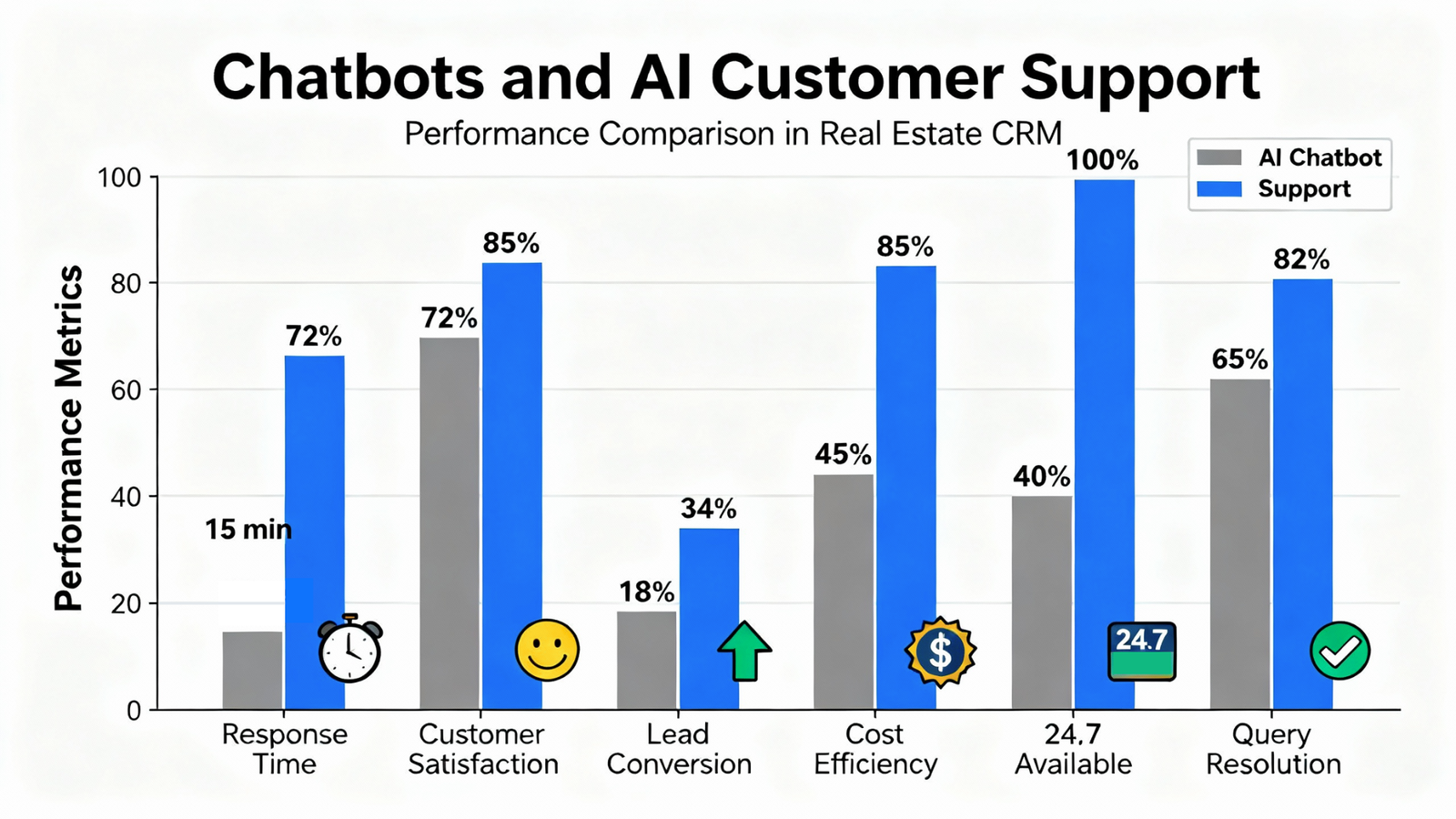
The collaboration of chatbots and AI-based customer support has drastically changed the way real estate companies interact with their customers. In an industry where the timing and the ability to respond c quickly might be crucial for the closing of a deal, the AI assistants make sure that every customer question is answered, no matter if it is day or night. Just think of a midnight visitor to your site who is interested in buying real estate — the smart chatbot would not let the customer wait until morning, please be sure that it will respond right away, show the relevant property listings and even schedule a viewing for the customer.
The customer interaction will be made easier by this around-the-clock presence and the brand image will be uplifted as one that is alert and professional. Chatbots of today are highly sophisticated and not to be mistaken for mere automated responders. They can, depending on how sophisticated their features are, get to the human sentiment, purpose and background through the application of natural language processing (NLP) and machine learning technologies.
Let’s say, for example, a user sends the message, “I am interested in a three-bedroom apartment located close to the city center” — the chatbot will then, without any delay, go through your CRM database to filter out listings and present the user with the relevant options.
Recording user preferences like budget, location and property size for future interactions is also one of the chatbot’s capabilities. Besides, when chatbots are connected to your CRM system, they become more intelligent as days go by. Each conversation is a new input to the client database that gets enhanced with real estate CRM software which is then used with the sales agents to provide more personalized follow-ups. The result is a smooth AI-human partnership where the chatbot does the opening and your crew comes in when a lead is ready for the individual attention.
6. Document and Transaction Management
Paperwork has been one of the major issues in real estate operations for decades. The handling of property agreements, lease documents, payment receipts, and compliance certifications have always involved a lot of manual work that eventually led to time wastage, human mistakes, and sometimes even missing documents. However, in 2025, agents have gone digital and therefore, the whole of their administrative work is done through the Real Estate CRM software.
Among the modern CRMs, one can find that there is a central document repository where all kinds of documents from contracts, agreements to invoices can be uploaded, categorized, and accessed very fast. The version control feature reduces every editing that is done automatically and providing keeping a detailed history of changes so the team can easily get revert back to or read the content of the previous draft.
As one real estate manager shared,
“The shift from paper to digital wasn’t just about convenience — it was about control. With everything tracked, stored, and signed in the CRM, we’ve turned chaos into clarity.”
To sum up, document and transaction management functionalities have brought real estate operations to a new level in terms of both efficiency and professionalism. Ger rid of all the paper works, improve transparency, and introduce automated routines, these systems are now helping agents to devote their time to what is of utmost importance, building relationships and closing deals, instead of running after signatures and scanning files. In 2025, this ability is not anymore a luxury but a requirement if one wants to be in the competition and remain client-centered in the real estate business.
7. Security and Data Protection
Data security is the basic element that builds the trust between the real estate agencies and their customers in the era of digital. Modern CRMs today hold extremely sensitive client data such as financials, identity proofs, property papers, and transaction information. Hence, the protection of data has become a universal right and a business responsibility at the same time. Along with the rising of cyber threats and data privacy laws worldwide, the real estate industry has no choice but to invest in secure CRM systems that will be top-notch in confidentiality, integrity and compliance.
The new Real Estate CRM Software already incorporate security measures of enterprise-level which are way superior to the conventional protections in the form of passwords. Using end-to-end encryption is the method of data protection that no unauthorized person can see or hear. The security in modern CRM systems is so high that if a hacker were to intercept the data, it would be useless for him without the decryption key.
As one cybersecurity expert aptly said,
“Data security isn’t just about firewalls and encryption — it’s about earning trust. When clients share their financial and personal information, they’re placing their confidence in your system. That trust must never be broken.”
In our time where one data breach could cost a company years of accumulated trust, a secured CRM system is a protection and proof of professionalism at the same time. Customers want to be informed that their data is well-guarded, and if your CRM gives such guarantee, that will be the start of a long-lasting trust and customer loyalty.
Real estate firms in 2025 that combine the powerful security infrastructure, compliance preparedness, and superior data management practices will have no trouble in keeping their clients’ trust and their own reputation as the most precious assets.
The Bottom Line
By the year of 2025, a Real Estate CRM is not only a tool anymore but also the foundation of a flourishing property business. The real estate agents are obligated to integrate the latest technologies and methods among the corresponding techniques and tools in order not to be outdone in the battle for customer preference since the buyers and sellers are expecting nothing less than prompt replies, personalized treatment, and flawless communication. Today’s CRM systems include automated functions, analytics, mobile accessibility, and intelligent workflows to manage leads, monitor transactions, and to work efficiently all from a one platform.
The very essential characteristics such as AI-powered lead management, cross-channel communication, intelligent property management, workflow automation, and advanced security measures are the ones that really contribute to saving time, reducing errors, and increasing capital. They aid the agents in dedicating their attention to the core of their job which is building good client relations and successfully closing deals. By doing away with repetitive tasks and centralizing information, CRMs contribute towards businesses employing smarter as opposed to harder methods.
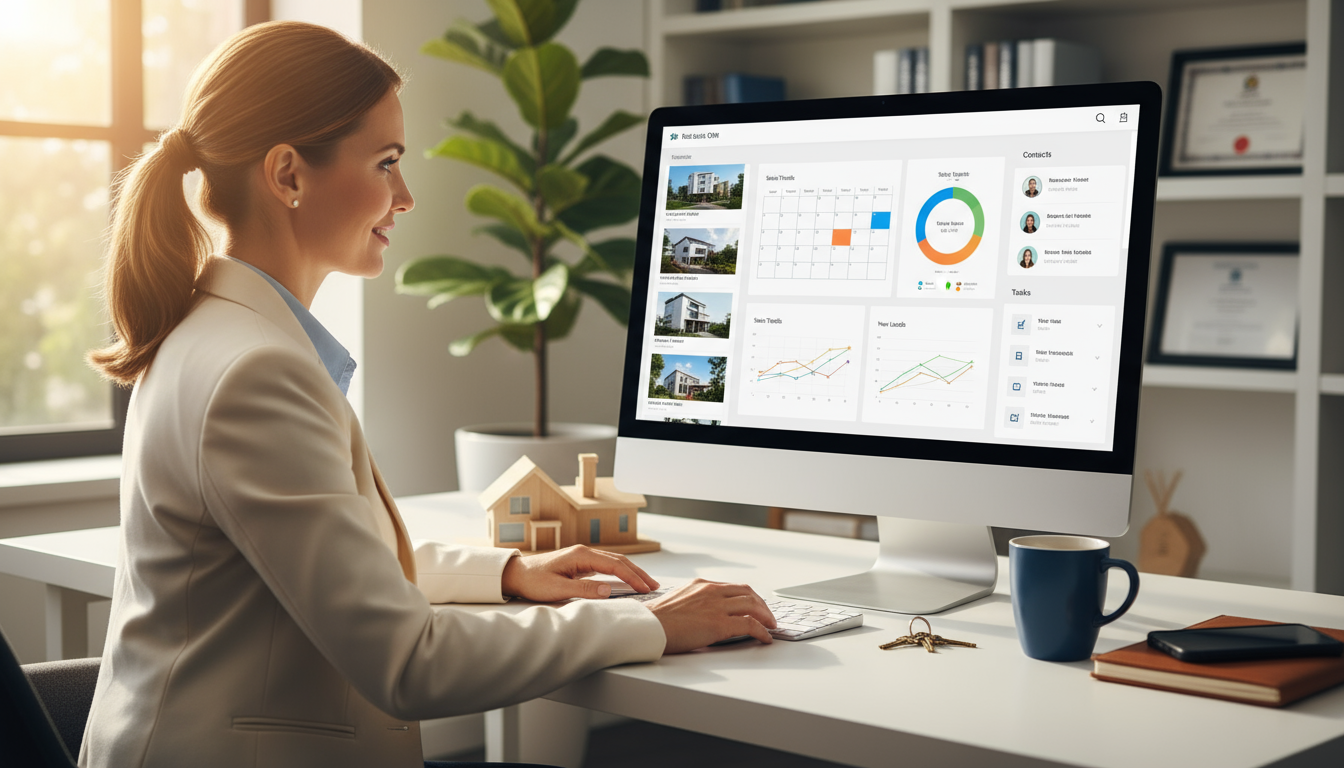
Moreover, the incorporation of chatbots, e-signatures, and real-time analytics has changed the nature of CRMs making them to be the smart business environments rather than simply the record-keeping systems. They give the organizations insights that can be acted upon, keep the clients of the organizations constantly engaged, and also they make sure that the transactions are safe and compliant. In a cutthroat real estate market scenario, these features are a must for the organizations to keep on being the winners and for the clients to continue being trustful.
To sum it up, a properly executed Real Estate CRM allows agencies to outsmart competitors in a fast-moving market, convert data into opportunities, and operations into efficiency. This is the gist of one industry expert’s observation who said,
“A good CRM doesn’t just help you sell properties — it helps you build a business that never stops growing.”
In 2025 and beyond, real estate professionals seeking to excel must not only consider investing in a modern, secure, and feature-rich CRM as a strategic advantage but also regard it as a necessity. The ones using these tools will have the upper hand in providing outstanding customer service, nurturing client relationships, and achieving long-term success in a digital world that continues growing.
